Diaspora-Led Cancer Screening and Education in Buea: Building a Model for Cameroon
Overview
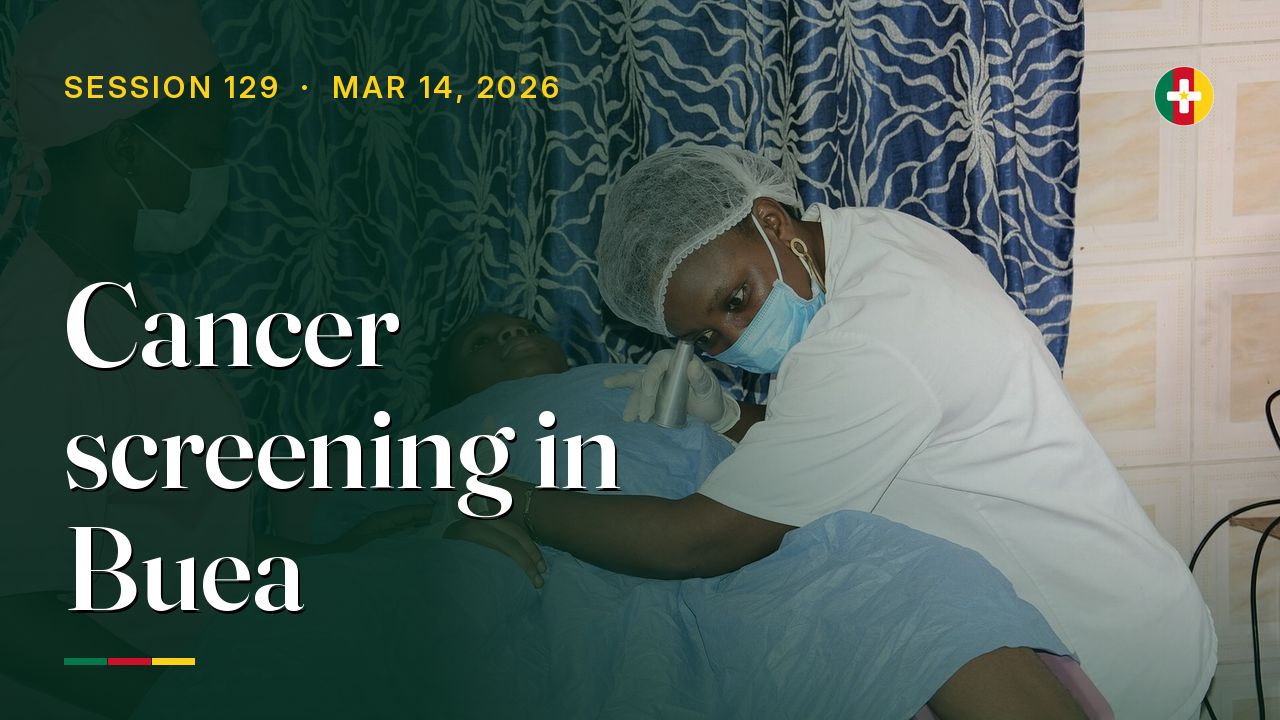
This policy briefing synthesizes key insights from the 129th session of the Cameroon Town Hall for Healthcare Professionals, held on March 14, 2026, on the ACPA 2026 Cancer Screening and Advanced Cancer Education Program in Buea (March 24 to 27, 2026), presented by ACPA President Dr. Luegenia Ndi and Medical Missions Chair Dr. Munoh Kenne Foma.
Context
Breast, cervical, prostate and colorectal cancers are often diagnosed late in Cameroon. The country has no national cancer screening guideline, colonoscopy was not available in the South West, and referral pathways are fragmented. ACPA, with the Buea Regional Hospital, the University of Buea and CLEAR Radiology, planned free or subsidised screening alongside CME teaching and tumour boards.
Key issues
- No national screening policy. Screening happens only through campaigns, so most cancers present late.
- Cost barriers. A mammogram costs about 17,500 FCFA, and even a 3,000 FCFA fee can deter people.
- Fragmented care. Patients diagnosed do not know where to go, specialties work in silos, and regional tumour boards do not exist.
- Continuity after campaigns. Campaigns can be overwhelmed and stop when funding or managers change.
- Low HPV vaccine uptake. The vaccine is free, but rumours about sterility limit uptake.
Discussion highlights
- The programme was built into the regional hospital so that screening and follow-up continue after the mission.
- Clear communication on what is free and what is not was seen as essential to trust.
- The National Cancer Control Committee planned to use the event to launch regional tumour boards and test low cost colorectal screening.
- Local data from local equipment were seen as necessary for any future AI tools.
- HPV vaccination should be promoted as cancer prevention.
Recommendations
- Adopt national screening guidance. MINSANTE and the National Cancer Control Committee should issue national guidance for breast, cervical, colorectal and prostate screening adapted to available resources, using the Buea results. First step: a review of the Buea data with ACPA and the University of Buea.
- Launch regional multidisciplinary tumour boards. Regional delegations and regional hospitals, starting in the South West, should set up tumour boards linking pathology, radiology, surgery and oncology, with diaspora specialists joining online. First step: a standing monthly board at the Buea Regional Hospital.
- Formalise referral and counter-referral. Hospitals and regional delegations should define pathways from screening sites to diagnostic and treatment centres (Douala, Mbingo, Yaoundé) and back, so patients are followed near home. First step: a written pathway for screen-positive patients from the Buea campaign.
- Remove small fees and communicate clearly. Organisers of public campaigns should waive registration fees where possible and state costs plainly on all materials. First step: one community flyer per campaign listing every charge.
- Strengthen HPV vaccination. The Expanded Programme on Immunization, schools and community health workers should frame HPV vaccination as cancer prevention for girls and boys aged 9 to 11 and counter sterility rumours. First step: joint messaging with faith and community leaders.
- Turn missions into partnerships. ACPA, the University of Buea and the Ministry's diaspora platform should sign memorandums of understanding for recurring missions, CME and joint research, and build a cancer registry from campaign data. First step: an MOU between ACPA and the University of Buea.
Next steps
Screening and teaching were to run from March 24 to 27, 2026, with a working session requested by the National Cancer Control Committee and feedback afterwards. ACPA planned to report on the mission at its April 24 to 26 conference in Atlanta. Elvis Ndansi's $5,000 donation was earmarked for screening.
Conclusion
The session presented a diaspora mission designed to leave something behind: screening embedded in a public hospital, trained local staff and the first steps toward regional tumour boards. Participants agreed that clear communication, follow-up and national screening policy will decide its lasting value.
Meeting minutes
Agenda
- Welcome and introduction by Elvis Ndansi
- Presentation of ACPA by its President, Dr. Luegenia Ndi
- Presentation of the ACPA 2026 Cancer Screening and Advanced Cancer Education Program by Dr. Munoh Kenne Foma
- Discussion and Q&A
- Remarks by ACPA members and partners
- Closing remarks
Opening remarks
- Elvis Ndansi said giving back is a core pillar of the town hall, which started its giving back initiative two years earlier and now counts about 2,450 participants in about 36 countries. He said giving back is a responsibility, not charity: transferring skills, building systems and mentoring.
- He introduced the session on the ACPA programme in Buea, run with the Buea Regional Hospital and the University of Buea Faculty of Health Sciences, and noted that too many cancer patients in Cameroon are diagnosed late.
Presentation
1. ACPA and its mission
Dr. Ndi said ACPA was about to celebrate its tenth anniversary in Atlanta in April, with about 150 registered members across 23 specialties. Its aims are professional development and networking, integration of Cameroonian trained physicians into US medicine (at least about 35 residents placed with ACPA support, including the Chair), a forum on health issues, involvement in care and policy in Cameroon, and training physicians who stay in Cameroon. This would be ACPA's first physical mission in Cameroon after earlier support to groups on the ground.
2. Why Buea, and why now
The Chair said Buea was chosen because it was relatively stable, as a model to be repeated elsewhere, including Bamenda, once conditions allow. Many ACPA members trained in the US, so the mission was also a fact finding visit. He said Cameroon has no national screening guideline for any cancer, and that ACPA would use the experience to advocate to the Minister for regular screening.
3. The cancer burden seen locally
He described a rising burden of breast cancer, persistently high cervical cancer, prostate cancer in men and rising colorectal cancer. Surgeons at the regional hospital see colon cancer only at obstruction, metastasis or ascites; there was no colonoscopy service in the South West, referral pathways are fragmented, and rural patients often attribute cancer deaths to witchcraft. He noted the Minister had made mammography available in all 10 regions.
4. Screening offer
Screening for breast, cervical, prostate and colorectal cancer would run at the Buea Regional Hospital and CLEAR Radiology from Tuesday March 24, after a fact finding day. Breast screening would include clinical examination with ultrasound or mammography, using a threshold of 40 years, aiming at over 300 mammograms; a mammogram normally costs about 17,500 FCFA. Cervical screening, digital rectal examination with prostate screening, and faecal occult blood testing (FIT not being available) would be offered, with referrals for colonoscopy to partners in Douala.
5. Education and tumour boards
Daily symposiums at the University of Buea would cover breast (Tuesday), colorectal (Wednesday), cervical and prostate cancer (Thursday), with a multidisciplinary tumour board on Friday. Sessions would include hands-on workshops and decision making in resource limited settings, open to physicians, nurses, students and patients. The Chair stressed teamwork: 'no tissue, no issue', with pathologists and radiologists as important as oncologists. He said the aim was to start a multidisciplinary tumour board in the South West.
6. Partners
Partners named included Prof. Halle-Ekane (University of Buea), Dr. Mokake Divine, director of the Buea Regional Hospital, Sidney Tazeh of CLEAR Radiology, Dr. Yauba Saidu of the Clinton Health Access Initiative, Dr. Joshua Tambe as local lead, the Cameroon Oncology Center (which would present on radiation oncology, noting Cameroon has one linear accelerator and a cobalt machine that is often down), Mbingo's radiation oncologist, faculty from Yaoundé and Bamenda, and the US Embassy. The Chair said the Minister of Public Health supported the programme and offered to intervene if administrative obstacles arose; clearance from the Cameroon Medical Council had been obtained.
7. Expected outcomes
Goals were early detection in the community, a programme backed by the regional hospital for continuity, practical cancer care skills for local staff, guideline based multidisciplinary care, stronger referral and follow-up, and a scalable model for future programmes. Members travel at their own expense.
Discussion and Q&A
- Elvis Ndansi (from the chat): will costs be clearly communicated so patients are not surprised by fees? An ACPA leader said cervical, prostate and colorectal screening and registration are free; for mammography, a 3,000 FCFA hospital registration fee applies while the mammogram itself is covered by ACPA. Dr. Tambe said each mammogram includes a full clinical examination and must be archived for future comparison, which the registration covers. A participant later urged that 'free' must mean free, and Elvis Ndansi noted that 3,000 FCFA is a lot for many Cameroonians. The Chair said new donations might allow the fee to be waived.
- Elvis Ndansi: how will you handle an overwhelming turnout, as happened with a kidney disease screening in the South West and Littoral that reached 35,000 people in under three months? The Chair said patients would be given appointments for later days and that the programme was built into the regional hospital and CLEAR Radiology so screening could continue. A participant suggested registering people in advance by cancer type. The Chair said the hospital director had set up a team to separate campaign flow from routine activity, with daily coordination meetings.
- How will continuity of care be ensured? The Chair said the work runs through existing government structures, with the regional hospital setting up a referral system and the Cameroon Oncology Center and Mbingo teams involved, and that memorandums of understanding with US teaching hospitals would follow. An ACPA leader stressed referral and counter-referral back to the patient's own facility, to spare patients the cost of staying in Douala.
- From the chat: will the data be used to build AI diagnostic tools trained on African patients? Dr. Fackche said data would be recorded and that locally driven research is needed. Dr. Tambe said algorithms trained elsewhere do not transfer well, so local images from local equipment should train local models, while warning against AI hype. He said the Permanent Secretary of the National Cancer Control Committee planned to attend all four days and use the event to launch regional multidisciplinary tumour boards, and had asked how the team planned 400 faecal occult blood tests for 400,000 FCFA (about 1,000 FCFA per test), with a view to scaling it during colorectal cancer awareness month.
- A paediatrician and medical school teacher: what about HPV vaccination? The Chair said HPV vaccine is free in the national programme, supported by Gavi and UNICEF, now given to girls and boys aged 9 to 11, and that the main barrier is rumours that it sterilises girls. The programme would reinforce education rather than run vaccination. The paediatrician suggested framing it as cancer prevention rather than linking it to sexual activity.
- Dr. Benjamin Vabi (comment) He cited an 11% rise in colorectal cancer incidence in Cameroon from 1999 to 2017, more cases in young people, a suture clinic for students, a case list being prepared with Dr. Mokake, and challenged local scientists to develop a local stool screening test.
- Prof. Alan Tita, ACPA board chair (comment) He recalled working in Acha after medical school, endorsed the programme on behalf of the board, and said health problems ultimately lie with politics, so professionals should engage to put the right decision makers in place.
- Sidney Tazeh, CLEAR Radiology (comment) He said his staff were ready, that breast cancer is a cancer where early diagnosis makes a real difference because treatment exists in Cameroon, and that the cohort of about 300 women would give a first picture of incidence, as more women in their 30s are being diagnosed.
- Dr. Florence Zeh Kakanou, Permanent Secretary, National Cancer Control Committee (comment) She asked for a working session with the team during the visit and feedback afterwards on lessons learned, and said the national committee belongs to everyone.
Calls to action and closing
- Elvis Ndansi announced a personal donation of $5,000 earmarked for screening; Dr. Ndi committed that every franc would go to screening patients.
- A surgical oncologist and palliative care physician from Chicago said it would be her first visit to Cameroon and that she saw it as a chance to learn about palliative care there. Prof. Fobi said he was one of ACPA's founders and was proud to see the two groups together.
- Dr. Ndi invited physicians to the ACPA annual conference in Atlanta, April 24 to 26, 2026 (acpacmr.org), where the President of the Cameroon Medical Council, Dr. Rudolph Fonkoua, was expected, and said a report on Buea would be presented there.
- The Chair thanked partners and the ACPA board for funding, noted the town hall's past support to cholera and COVID-19 programmes and to the Cameroon English-speaking medical students' (CAMESA) campaign, and said the Minister had promised the day before to help remove any obstacles.
- Elvis Ndansi closed by calling the programme an example of diaspora and local professionals working together.
Submitted by the Co-Moderators, Cameroon Town Hall for Healthcare Professionals.