Science, Politics and Funding: Strengthening African Health Research Careers and Agendas
Overview
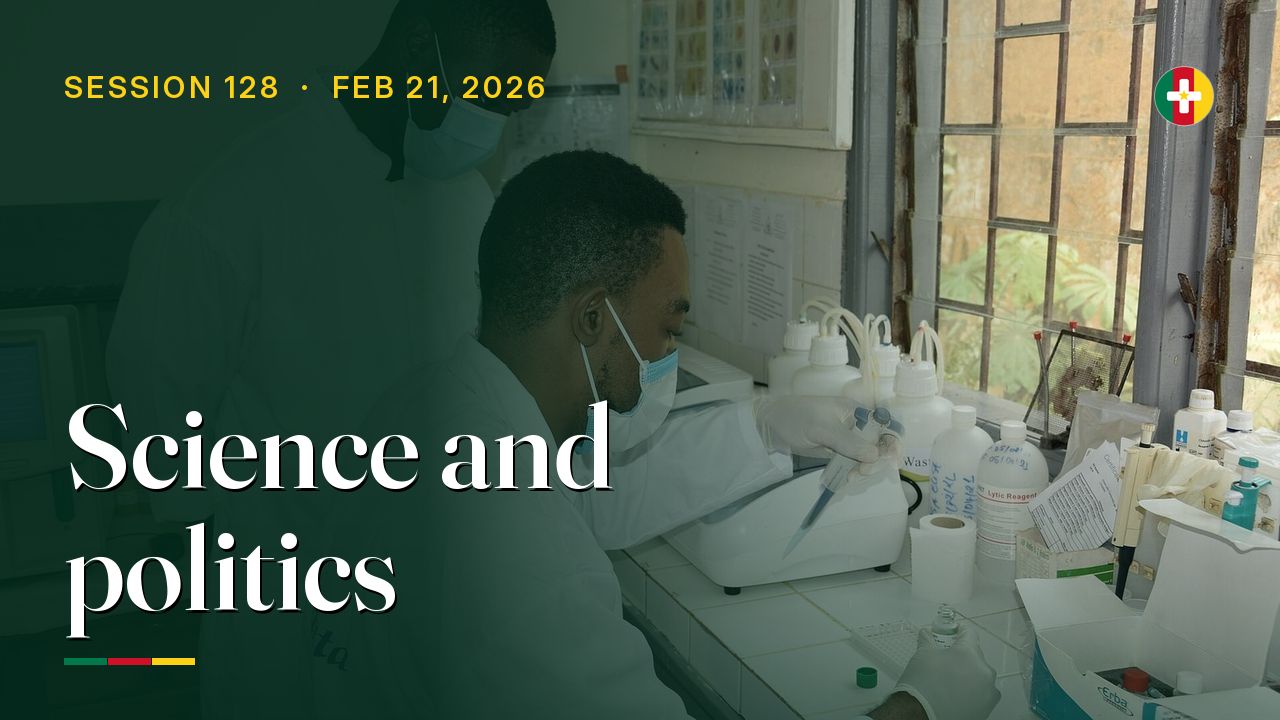
This brief draws on Session 128 of the Cameroon Town Hall for Healthcare Professionals, held on February 21, 2026. Dr. Luchuo Engelbert Bain, physician, bioethicist and head of international programmes at APHRC, spoke on careers, funding and Africa's place in a changing global health order. Participants discussed research funding, mentorship, science communication and engagement with policymakers.
Context
Cuts in international development funding have reduced jobs and increased competition for grants in global health. Two-thirds of global health agencies are headquartered in three high-income countries, and most of their leaders are from and educated in high-income countries (data cited by the speaker). Few African governments fund their own research, the Abuja target of 15% of public budgets for health is largely unmet, and early career researchers in Cameroon face weak mentorship and authorship disputes.
Key issues
- A shrinking job market. Public health graduates outnumber jobs, and the traditional NGO, government or academic path is no longer secure.
- Research agendas set elsewhere. External funding shapes priorities, and national research funding and plans are weak or absent.
- Evidence that does not reach policy. Researchers inform politicians late and in the wrong format; policy briefs alone rarely change decisions.
- Weak mentorship and research integrity. Student work goes unpublished or supervisors take credit, and predatory publishing harms careers.
- Misinformation outpaces science. Anti-science movements are funded and organised; science communication is not.
Discussion highlights
- Dr. Bain: if you don't do the politics, the politics will do you.
- Dr. Bain: decolonisation must start from the inside, with national funding and equitable African partnerships.
- Dr. Bain: an ethics approval is not legally binding, but it is legally relevant.
- Dr. Bain: there is no evidence that evidence on its own brings change.
- A participant: join the committees where decisions are made.
Recommendations
- Create national research funding. MINSANTE and the Ministry of Scientific Research and Innovation should establish or strengthen a national health research fund with a public research and development plan, so that external grants add to national priorities rather than set them. First step: publish national health research priorities and a funding target.
- Make mentorship count in academic promotion. Universities and the Ministry of Higher Education should include the quality of mentorship, student publication and fair authorship in promotion criteria, and set clear rules on authorship of student theses.
- Teach health politics, ethics and science communication. Faculties of medicine, nursing and public health should add modules on health politics and diplomacy, research and publication ethics, critical thinking and communicating with policymakers and the public.
- Involve policymakers from the start. Research institutions, the town hall and partners should engage relevant ministry officials and parliamentarians at the design stage of research, and present results in formats and at times that fit their agendas, with support from communication specialists.
- Fund proactive science communication. MINSANTE, professional associations and partners should fund a standing science communication effort on social media and radio to counter health misinformation, using trusted clinicians and researchers.
- Build trust for African philanthropy. Institutions seeking local funding should adopt certified grant management standards, and government should consider tax incentives for donations to health research.
Next steps
The town hall will continue sessions on careers and research for early career professionals, share Dr. Bain's slides, and invite him to return.
Conclusion
The session argued that African health professionals need political skill, ethical grounding and a strong network as much as technical expertise, and that Africa's place in global health depends first on what African institutions fund and do for themselves.
Meeting minutes
Agenda
- Welcome by the moderator, Elvis Ndansi
- Remarks by co-moderators Dr. Katte and Dr. Tegomoh and by the Chair
- Introduction of the speaker by Dr. Katte
- Presentation by Dr. Luchuo Engelbert Bain
- Comments from the moderators and Chair
- Questions and answers moderated by Dr. Katte
- Closing remarks
Opening remarks
- Elvis Ndansi welcomed participants to the 128th session, noting that the town hall had met for over five years without missing a month and has over 2,400 members in 36 countries. He framed the theme around who sets the research agenda, who controls funding and who tells Africa's story in science.
- The Chair, Dr. Foma, quoted a former teacher: if clinicians are not involved in politics, politics will direct their careers for them. He announced the ACPA cancer screening and education programme in Buea the following month and asked participants to mobilise the public.
- Dr. Katte introduced the speaker as a physician, empirical bioethicist and global health strategist, newly elected Fellow of the African Academy of Sciences, head of programmes at APHRC, author of over 100 peer-reviewed papers, an editor of the Pan African Medical Journal and convener of Global Health Otherwise.
Presentation
1. The old career model is gone
Dr. Bain said universities produce far more public health graduates than there are jobs, and that recent cuts mean even a job today is no guarantee tomorrow. Graduates were trained to work for NGOs, governments or academia; the field now needs innovators and entrepreneurs who find where they can add value. Nothing will be given on a platter, and conformity is no longer safe.
2. Health is politics
Citing work on the political determinants of health, he said most of what affects health lies outside the health sector and that public health ends in influencing politicians, yet public health professionals are rarely trained in politics or diplomacy. He argued for teaching health politics and for bringing political scientists and diplomats into the centre of global health, not consulting them at the end.
3. What an intellectual owes
Drawing on the Foundation for Critical Thinking, he defined an intellectual as a moral authority who meets standards such as clarity, accuracy, relevance and fairness, and virtues such as integrity, humility and courage. He said these should be taught from the first year of university.
4. Publishing and research ethics
Publications matter in practice even when not listed as criteria. He warned against predatory journals, duplicate publication and authorship misconduct, since a single bad paper can define a researcher online. Ethics approval is not a burden: it is not legally binding but it is legally relevant when problems arise years later. He cited the Emanuel criteria for ethical research and the ethics debate around a recent trial in Guinea-Bissau.
5. Decolonising global health, critically
He described himself as both a proponent and a critic of decolonisation. Two-thirds of global health agencies are headquartered in Switzerland, the UK and the US, and most leaders are men from and educated in high-income countries. Yet the discourse is dominated by scholars in northern institutions, frameworks come from the North, and some of the most inequitable partnerships he had seen were between African institutions. Change must start from the inside: fund national research (he cited Rwanda's government-funded research), stop creating unfunded structures and declarations, revise curricula, and define and monitor equitable partnerships.
6. Who is a global health expert
There is no agreed definition or credential, but he said it is clear who is not one: those with knowledge without context, one-dimensional expertise, superficial short-term engagement, or a saviour mindset.
7. How funding really works
Competition has grown sharply (one German university's EDCTP applications rose from 24 to 163 in a year). Not all funders advertise; he said about 38% of US funding comes from anonymous donors, and some bilateral funders favour partners from countries that contributed to a given call. As a former programme officer at IDRC, he advised respecting word limits, reporting on time, tagging funders, keeping two or three concept notes ready, joining consortia and staying visible online, because funders talk to each other and non-competitive grants go to people in their good books.
8. Networking, mentorship and attitude
Networking should be intentional: research the two or three people you want to meet and connect in 90 seconds. Mentees should be adaptable, curious, accountable and humble. He named five career myths: that your work will speak for you, that conformity is safe, that you should act only when perfect, that years of experience mean being right, and that taking risks alone is reckless. His advice: credentials alone will not protect you, write with clarity, learn AI, learn the politics, find mentors early, protect your mental health and be your own competition. Funding decisions are never purely technical.
Discussion and Q&A
- Moderators' reactions. Elvis Ndansi recalled that his undergraduate seminar paper on nurses and politics at the University of Buea caused a scandal because he argued that without nurses in parliament Cameroon would never have a nursing order. Dr. Foma said credentials alone no longer guarantee security and stressed AI literacy and entrepreneurial thinking.
- Dr. Samuel Ndinjiakat: how do we move from talk to action and pool our resources? He described 15 years at Grace Gardens Hospital in Ndop and partnerships with groups in Rwanda, Sweden and Switzerland, and said the town hall's value is in bringing people together. Later he asked how to change the mindset that the West must do things for Africa; Dr. Bain said many African philanthropies want to fund African work but trust is a barrier, so institutions must show sound financial management (APHRC offers a Good Financial Grant Practice course) and package research as a driver of development aligned with companies' corporate social responsibility.
- A participant asked about scientists' silence on vaccine misinformation, whether decolonisation risks entrenching bad leaders, the unmet Abuja target of 15% of budgets for health, and politicians seeking care abroad. Dr. Bain said the right people must enter politics and citizens must hold leaders accountable. Decolonisation starts with how we think, including rethinking what counts as knowledge and evidence. He described 'scholarly pollution' and 'scholarly constipation' and said misinformation movements are well funded, structured and proactive while science communication is not, so it must be funded and placed on social media where people are. Dr. Foma added that ivermectin and albendazole, promoted by some as suppressed cancer cures, are themselves made by large pharmaceutical companies.
- A participant described an article on product dumping in Africa rejected by a sponsor-backed meeting in Switzerland, and asked how to fund change in systems built by outsiders. Elvis Ndansi said African institutions must fund and credit their own research rather than rely on outside platforms. Dr. Bain added that packaging and diplomacy matter, and that partnering in dignity sometimes means refusing an inequitable partnership. External funding should be an add-on to national research and development plans.
- A chat question: research done by students in Cameroon stays in supervisors' drawers, or supervisors take first authorship. Dr. Bain called this a moral failure of the academic system and said, citing a paper he co-wrote on promotion in African academia, that the quality of mentorship should be a key criterion for academic promotion.
- Dr. Ntumsi Tontu: what motivates young people entering public health, and how can local politicians be engaged on basics such as waste management? Dr. Katte said public health professionals are needed in transport, local councils and agriculture, not only in health. Dr. Bain said many enter public health without knowing the range of opportunities, that learning should be two-way (he said UK primary care could learn from Kenya), and that politicians must be involved from the start.
- A cardiologist in the United States on getting involved, and on strings attached to bilateral funding. He urged everyone to join committees in their institutions, describing how joining service line committees gave him a say in purchasing. He welcomed the African Union target for 60% of vaccines used in Africa to be made in Africa by 2040.
- Other participants on scientists in politics, anonymous donors and why politicians ignore evidence. Dr. Bain said evidence is not taken up when politicians are informed only at the end, so they should be involved from the start, and findings must be framed for their agendas and timing with help from communication and political specialists. He said his preliminary review suggests policy briefs on their own rarely change policy unless their process, timing and political entry points are right. A culture of giving can be built with recognition and tax incentives tied to research and development, within an ecosystem of trust.
- Dr. Tegomoh: with AI agents able to draft concept notes, reviews and protocols in minutes, what is the true currency for early career researchers? Dr. Bain said failing to use AI tools responsibly is now unethical, but human agency, dedicated thinking time and continuous learning still set people apart. The true currency is recognising the system is broken, building a niche where one adds value, structured networking and the right attitude.
- Dr. Katte: what three things should an early career researcher add beyond expertise? Expect gains over 5 to 10 years and put in the work consistently; make yourself teachable, including by volunteering early; and look after your mental health and be your own competition.
Calls to action and closing
- Dr. Foma said public health is what we do not notice until politics makes it fail, and that the large gains in life expectancy since the 18th century came from hygiene and sanitation, antibiotics and vaccination. He showed the ACPA flyer for the Buea screening campaign and asked participants to share it.
- Dr. Katte thanked the speaker, noting that very few participants left although the session ran 50 minutes over time.
- Dr. Bain thanked the town hall and hoped to return.
Next meeting
Not announced in the session.
Submitted by the Co-Moderators, Cameroon Town Hall for Healthcare Professionals.