Preparing Cameroon's Health System for Artificial Intelligence
Overview
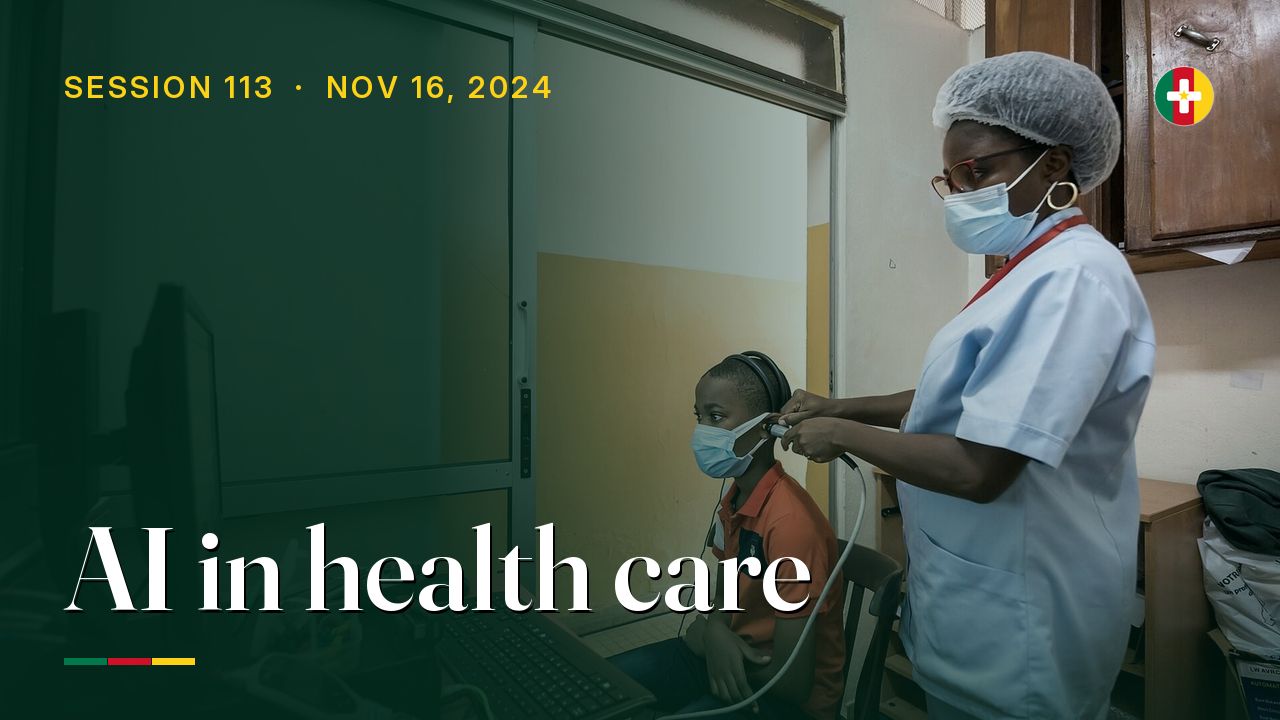
This policy brief synthesises key insights from the Cameroon Town Hall for Healthcare Professionals meeting held on November 16, 2024 (113th session), a special edition on 'AI and the Future of Health Care' moderated by Dr. Bryan Tegomoh.
Context
AI tools for documentation, diagnosis, imaging, laboratory work and research are spreading quickly. Cameroon has a National Digital Health Strategic Plan, but participants found no mention of high performance computing or data centres, most clinical records are handwritten, and power and internet remain unreliable in rural areas.
Key issues
- Data foundations. Handwritten notes and limited electronic records mean little local data exists to train or validate tools.
- Infrastructure. Unstable electricity, weak connectivity and no national computing capacity limit deployment.
- Privacy and security. There is no clear guidance on entering patient data into AI tools, on consent for AI scribes, or on where health data is hosted.
- Safety and bias. Tools trained on foreign data may perform poorly on local diseases such as malaria, and generative models can produce confident errors.
- Dual use and governance. Open biological design tools could be misused, and global and national regulation is still forming.
Discussion highlights
- Generative AI can deliver value in Cameroon before a national EMR exists, for example through WhatsApp based tools.
- Behaviour change and trust among providers are bigger barriers than technology.
- Regional cooperation could share computing and data costs.
- Every deployment should be tested against defined metrics with a control group.
- Clinicians must keep reviewing AI output and retain core skills.
Recommendations
- Issue national guidance on AI use in health. MINSANTE, with the Ministry of Posts and Telecommunications, should issue interim guidance on acceptable clinical AI use, patient consent for AI scribes, de-identification, and accountability for AI assisted decisions. First step: a technical working group including clinicians, data scientists and diaspora experts.
- Digitise records as the base for AI. MINSANTE and hospitals should accelerate electronic records and pilot AI assisted digitisation of handwritten notes in selected regional hospitals, with human review of accuracy.
- Protect health data. Government should enforce data protection rules for health data and decide, through the digital health plan, on local, regional or foreign hosting, with security standards for any vendor.
- Require local validation and controlled pilots. Hospitals and partners should test AI tools on Cameroonian data and conditions (for example malaria) in controlled pilots with clear metrics before wider use, and report results.
- Build skills and regional partnerships. Training schools should add AI literacy to medical, nursing and public health curricula, and Cameroon should explore regional data and computing partnerships with neighbouring countries. Diaspora data scientists and clinicians can teach through town hall sessions.
- Invest in power and connectivity. Government and private partners should prioritise reliable electricity and internet for health facilities so that DHIS2 and future AI tools work at district level.
Next steps
A follow up session on AI best practices across professions was proposed by a participant. The session of November 30, 2024 was cancelled for the US Thanksgiving weekend.
Conclusion
Participants agreed that AI offers Cameroon a chance to leapfrog gaps in documentation, diagnosis and training, but only with sound data, security, local validation and human oversight. Starting with small, well measured pilots was seen as the practical first step.
Meeting minutes
Agenda
- Welcome to the 113th session by Dr. Munoh Kenne Foma and Dr. Bryan Tegomoh
- Framing: AI and the fourth industrial revolution
- Chair's remarks on AI in medicine
- Open discussion
- Video: TED talk by Dr. Eric Topol on AI and medical diagnosis
- Contributions from participants, including a data scientist from a US healthcare startup
- Closing remarks and next meeting
Opening remarks
- Dr. Tegomoh framed AI as the core of a fourth industrial revolution that will affect every sector, as steam, electricity and computing did, and noted that global competition has moved to GPUs and computing power.
- He said the session would be interactive rather than an expert lecture, aimed at hearing how participants use AI, which sectors are changing, and what Cameroon needs in digital infrastructure, along with ethical, data security and liability issues.
Presentation
1. Where AI already helps clinicians
Dr. Foma described AI as a tool that could help developing countries close a 100 year gap in months. He cited uses already in practice: summarising years of patient records before a visit, ambient AI scribes that draft notes from the conversation, summarising new research from conferences such as ASCO for a specific patient, and image analysis in radiology, ECGs and retinal photographs. He said AI would not replace doctors but those who refuse to use it may be left behind.
2. Risks: bias, privacy, hallucination and dual use
Dr. Foma warned that biased training data produces biased outputs, that entering patient data into tools such as ChatGPT raises privacy and HIPAA questions, and that models can 'confidently tell lies' (hallucinations). Asked by Dr. Tegomoh about open source protein structure tools such as AlphaFold, he agreed they could be misused to design harmful proteins or modified viruses, and said regulation is needed without stifling science, ideally through UN level principles signed by all countries, as with nuclear weapons.
3. Regulation, cost and Cameroon's starting point
Dr. Mpollo noted that the UN adopted a resolution on safe AI in March 2024 and said tools to detect AI generated output are lagging. She asked who will pay for AI tools, noted that patients must be able to consent to and redact AI scribe transcripts, and warned that clinicians may lose note taking skills. For Cameroon, she suggested first using AI to digitise handwritten notes, and using prescription data to forecast and tender for medicines. Dr. Tegomoh cited a Nature paper warning that models trained recursively on AI generated content degrade.
4. Evidence from the Topol talk
The TED talk by cardiologist Dr. Eric Topol of Scripps Research covered AlphaFold, the National Academy of Medicine's finding that everyone will experience a diagnostic error, a Johns Hopkins estimate of 800,000 Americans dead or seriously disabled each year from such errors, retinal and ECG models that detect conditions humans cannot see, and a retinal foundation model trained on 1.6 million images. He described cases where ChatGPT suggested diagnoses missed by many doctors and 'keyboard liberation' through AI generated notes.
5. A data scientist's view
The data scientist explained that many AI methods, such as linear regression, are long established but now run faster on modern computing. She urged that AI notes and decision support be checked by clinicians and validated locally, since a tool built for US conditions may fail for malaria in Cameroon. She said generative AI tools can be useful in Cameroon before a national electronic record exists, but information security, data sovereignty choices (local versus foreign servers) and enforcement of privacy laws are prerequisites for wider use.
6. Laboratory and pathology applications
Dr. Kenji described AI enabled microbiology systems that plate, incubate and identify bacteria from images, and digital pathology work at Stanford that trains systems on slide images to support diagnosis. He said AI also helps summarise large documents, such as a 300 page meeting transcript.
Discussion and Q&A
- Dr. Tegomoh asked what digital infrastructure Cameroon needs for AI. The data scientist cited information security, data protection law with enforcement, and a decision on local or foreign data hosting. A participant with DHIS2 implementation experience in Cameroon added reliable electricity and internet (noting reports of 2G and 3G networks), capacity building and involvement of policy makers, and investment in curated local data. Dr. Foma called for regional partnerships with countries such as Nigeria, Ghana and Central African neighbours to share data and computing costs, and engagement of the relevant ministries and the private sector.
- A participant described reviewing the terms of over 100 AI tools and asked how far AI can be controlled. He noted that all warn they can make errors, cited AI meeting assistants and the Cameroonian telemedicine app Waspito as examples, and said AI reduces time and cost but is hard to regulate. Dr. Tegomoh noted that AI is broader than large language models.
- An epidemiologist asked where people with no AI experience should start, and what uses are acceptable. The data scientist advised experimenting with free tools such as ChatGPT or Meta AI on WhatsApp, testing them on known topics to learn how they hallucinate, and keeping expert review of any clinical output. The participant who reviewed AI terms and Dr. Tegomoh said electronic medical records are the foundation, noting that Cameroon uses DHIS2 but power cuts limit data capture in rural areas.
- Dr. Mpollo described a WhatsApp based platform in Cameroon connected to a large language model through an API. She said the main barriers were not technical but behavioural: providers' fear of replacement and questions about payment, which require education. She stressed local data and human review for culturally competent tools.
- Dr. Tegomoh asked what children in school should focus on for the future. Dr. Foma urged that young people use free AI tools now. Dr. Tegomoh countered that understanding the foundations, such as how predictive models are built, remains important.
Calls to action and closing
- The data scientist proposed non-clinical uses such as AI scheduling to cut waiting times in clinics, and support for patients at home, and urged controlled experiments with clear metrics before wide deployment.
- Dr. Mpollo pointed to medical specific models from Google and Microsoft, and to Mila in Montreal's work on AI misinformation, and called for small experiments and accountability.
- A participant with DHIS2 experience announced a planned session with a medical doctor experienced in AI to share best practices across professions.
- Dr. Foma closed with 'don't let perfection be the enemy of good', saying AI should reach young Africans early and will relieve doctors of routine tasks rather than replace them.
- Dr. Tegomoh announced that the next fortnightly session would be skipped because it fell on the US Thanksgiving weekend.
Next meeting
Session of November 30, 2024 skipped (US Thanksgiving weekend); next session in four weeks (about December 14, 2024).
Submitted by the Co-Moderators, Cameroon Town Hall for Healthcare Professionals.