Decolonizing Global Health: The African Diaspora's Role in Advancing Global Health Equity
Overview
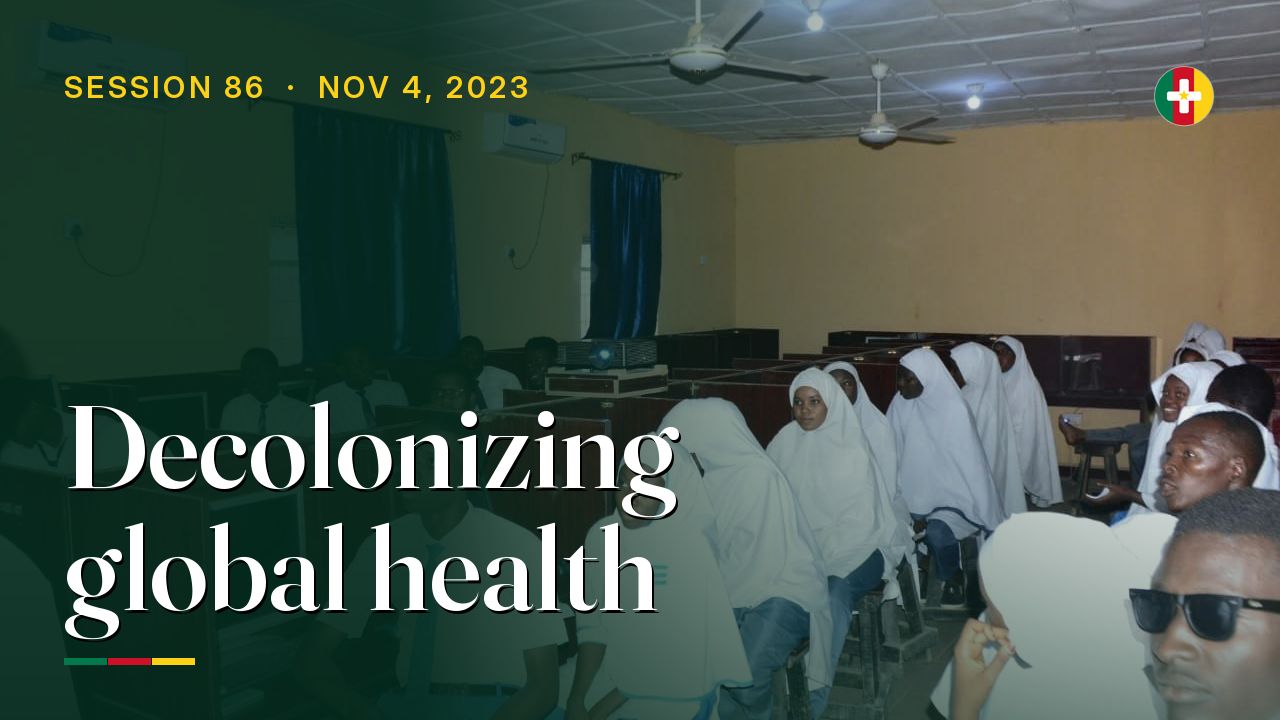
This policy briefing synthesizes key insights from the Cameroon Townhall for Healthcare Professionals meeting held on November 4, 2023 (86th edition), focusing on the theme "Decolonizing Global Health: The African Diaspora's Role in Advancing Global Health Equity," presented by Prof. Yap Boum II, Executive Director of Institut Pasteur de Bangui.
Context
Global health research and funding in Africa are still largely set by the global North. Participants stressed that decolonization must also come from within: Cameroon and other African countries have not met the Abuja Declaration target of 15% of national budgets for health, and programmes such as HIV treatment remain dependent on external funders.
Key issues
- Agenda set elsewhere. Research priorities, hypotheses and methods often come from the global North, and African authors are under represented in research done in Africa.
- Dependence on external funding. HIV, malaria and other programmes rely on donors, as the pending PEPFAR renewal showed.
- Weak domestic commitment. The 15% Abuja target is unmet and allocated health budgets are often not fully spent.
- Cameroon misses opportunities. Language, bureaucracy, slow ethics clearance, corruption and researchers working in silos reduce Cameroon's share of grants and trials; DAC-Africa had received no Cameroonian protocol in its first year.
- Few incentives for research. Researchers lack protected time and a decent living from research.
Discussion highlights
- Decolonization must start from within, with African governments setting and funding their own health agenda.
- Citizens and health workers should hold leaders accountable for health commitments.
- Diaspora members on funder boards should push for African representation.
- Researchers should collaborate rather than work in silos and choose journals by audience.
- Women and seasoned scientists should be represented in health leadership.
Recommendations
- Meet the Abuja commitment. The Government and MINSANTE should publish a path toward 15% of the national budget for health and report spending of allocated funds. First step: an annual public report on health budget allocation and execution.
- Plan for donor transition. MINSANTE and the national HIV and malaria programmes should develop costed plans to finance treatment domestically if external funding falls. First step: a scenario analysis of a reduction in PEPFAR funding.
- Make Cameroon competitive for research funding. MINSANTE, the national ethics committee and universities should shorten approval times, support grant writing in English and French, and encourage research networks instead of single investigators. First step: promote DAC-Africa protocol review and planning grants among Cameroonian investigators.
- Reward research careers. Universities and MINSANTE should provide protected research time and recognise both national and international publications in promotion.
- Organise diaspora contributions. The town hall and the Ministry's diaspora committee should match diaspora professionals as mentors, tutors, sponsors and hosts of internships with institutions in Cameroon. First step: a registry of diaspora volunteers by field.
- Strengthen leadership and accountability. MINSANTE should appoint seasoned scientists to technical posts such as laboratory directorates and the National Public Health Institute, ensure women are represented on advisory boards, and engage professional groups and the public in tracking commitments.
Next steps
Participants agreed the conversation should continue in future sessions. DAC-Africa was invited to present its programme to the town hall.
Conclusion
Speakers agreed that decolonizing global health means Africans setting their own agenda, funding their own health systems and telling their own stories, with the diaspora acting as mentors and partners rather than replacements for national leadership.
Meeting minutes
Agenda
- Welcome and opening remarks by the lead moderator, Elvis Ndansi, the co-moderators and the Chair, Dr. Munoh Kenne Foma
- Introduction of the speaker by Dr. Bryan Tegomoh
- Presentation by Prof. Yap Boum II on "Decolonizing Global Health: The African Diaspora's Role in Advancing Global Health Equity"
- Participant reflections
- Discussion and Q&A, led by Dr. Christelle Jouego Tagne
- Closing remarks by the Chair, summary by Elvis Ndansi, and parking lot
Opening remarks
- Elvis Ndansi welcomed participants to the 86th session and said about 2,270 Cameroonian health professionals in about 36 countries had attended at least one session. The town hall meets every fortnight at 1:00 p.m. Eastern and 6 p.m. Cameroon time.
- He thanked the Chair for the breast cancer educational session he organised the previous week for more than 70 participants, as an example of the diaspora giving back, and noted that the Chair had also presented on breast cancer in Cameroon two weeks earlier.
- The Chair said discussing a topic is the first step toward change and that the session would look at how the diaspora can use its voice and influence.
- Dr. Tegomoh introduced Prof. Boum, whom he first met at the African Philanthropy Forum in 2017. He described his work at Institut Pasteur de Bangui and Epicentre, his role as chief of operations of Cameroon's COVID-19 response, his co-founding of Kmerpad (washable sanitary pads to empower women), and his recent address on decolonizing global health at the ASTMH meeting in Chicago.
Presentation
1. Framing the problem
Prof. Boum opened by saying peace is essential to health, asked why we should be involved in global health, and built his talk on the concept of ubuntu, 'I am because you are'. He distinguished simple, complicated and complex problems and said global health problems such as pandemics and outbreaks of cholera or polio are complex and multisectoral, needing many stakeholders.
2. Equity and the lessons of COVID-19
He illustrated equity with the image of three people of different heights watching a match over a fence, each given the support they need to see. He described financial and logistical challenges and said COVID-19 showed that low and middle income countries were not a priority for drugs, diagnostics and vaccines.
3. Who tells Africa's story
He asked whether Africans are strategists capable of telling their own stories or mere implementers whose stories are told by others. He said the global North drives the research agenda and that African authors make up less than half of authors in collaborative research conducted in Africa, a gap that grows when African researchers have no protected time for research.
4. Research adapted to African realities
He said current models of global health are inequitable at the level of hypothesis, policy and implementation, and that research methods must fit African realities, for example asking whether people would prefer a malaria medicine as a tea or a tablet rather than assuming a capsule.
5. Solutions
He called for funding to go directly to institutions in the global South without intermediaries, more investment in the global South, open discussion of a 'new normal' with global South partners taking ownership of research, mentorship, joint grant writing as a community, and digital health tools, citing iDocta, to connect people with providers and specialists.
6. Roles for the diaspora
He said the diaspora can serve as mentors, tutors, sponsors, contributors and philanthropists, and can provide internships to colleagues at home. He closed with the proverb: 'Until the lions have their own historians, the story of the hunt will always glorify the hunter.'
Discussion and Q&A
- Reflections from Prof. Charles Shey Wiysonge and Dr. Boghuma Kabisen Titanji Prof. Wiysonge thanked the speaker and called on others to follow his example. Dr. Titanji said discussions of decolonization focus too much on external causes. Citing PEPFAR, which has run for over 20 years, is estimated to have saved 20 million lives and whose renewal was pending in the US Congress, she said African governments have had 20 years to plan HIV treatment that does not depend on external funders, and asked how to engage policy makers to value health and science.
- A participant: why place the burden of decolonization on the diaspora? He said no country has moved its health needle mainly through its diaspora, that the problem is less the global North's agenda than Africa having no agenda of its own, and asked what Africa learned from COVID-19 to prepare for the next pandemic. He noted that 22 years after the Abuja Declaration, governments have not reached the 15% health budget target and often fail to spend what is allocated, and asked whose commitment it really was.
- A co-chair of the LSHTM school health and nutrition consortium: is Africa ready, given funding, agendas, data control, structural incentives and unmet government commitments? Prof. Boum said the goal is interdependence, since disease crosses borders, and Africans must sit at the same table as funders; few board members of NIH, the Gates Foundation and similar funders come from Africa, so diaspora members in such positions should push for representation. He said citizens, bloggers and health workers must hold leaders accountable, for example on the Abuja Declaration, noting that the Minister of Public Health, Dr. Manaouda Malachie, responds when challenged on social media. He also said only 30 to 40% of students attend some medical school classes.
- A participant who works with civil society funders: why does Cameroon miss funding opportunities that go to Nigeria, Kenya and Ethiopia; is being francophone a barrier? Prof. Boum said language is the first barrier, since Cameroon competes less for grants, followed by bureaucracy, administration and corruption that make implementation harder, so funders go where results are easier. He urged advocacy with funders, citing the Gates Foundation's choice of Cameroon for DAC-Africa partly because it is bilingual. The Chair described a large company's attempt during COVID-19 to run early phase vaccine trials in a francophone country, which proved almost impossible in Cameroon because of slow ethics clearance, the political environment and lack of technical support.
- Elvis Ndansi on DAC-Africa He said each funder sets its own priorities, and described DAC-Africa (Design, Analyze and Communicate), a three year, $1.5 million Gates Foundation grant hosted by the Clinton Health Access Initiative in Cameroon, which reviews trial protocols and offers trial planning grants of about $30,000. In its first year it had received protocols from Nigeria and India but none from a Cameroonian researcher, which he blamed partly on researchers working in silos. Prof. Boum added that researchers need incentives and a decent living from research, and that champions such as Prof. Rose Leke should be promoted.
- Elvis Ndansi: do African researchers trust African journals? Prof. Boum cited Seye Abimbola's editorial 'The foreign gaze' in BMJ Global Health: choose the journal by the message and audience. A comment aimed at funders on indirect costs belongs in a journal such as NEJM, while a COVID-19 seroprevalence study in Cameroon may best reach African peers in Scientific African. He said the University of Yaoundé I distinguishes international and national publications in promotions.
- A former colleague of Prof. Boum: further practical points He said young African scientists must also be trained to publish in high impact journals, that research grants need accountability, that countries should support Africa CDC, including on vaccine manufacturing (Africa produces about 1% of its vaccines, as stated), that more women are needed on advisory boards, citing the HIGHER Women in science initiative of Prof. Rose Leke, and that seasoned scientists should lead laboratory directorates and the planned National Public Health Institute.
Calls to action and closing
- Dr. Tegomoh noted the backlash among researchers in low and middle income countries over a recent NIH policy change, and Dr. Titanji's comment that most Africa CDC funding also comes from the global North.
- The Chair said the take home message was to advocate for decolonization while holding leaders accountable, recalled the Abuja Declaration and asked what would happen to HIV, malaria and neglected tropical disease programmes if Western funding stopped. He said Cameroon has one of the most educated diasporas in Africa and that those at home and abroad should not feel threatened by each other.
- Elvis Ndansi summarised the presentation and closed the session, followed by the parking lot.
Next meeting
The next sessions were on heart disease (November 2023) and HIV (December 2, 2023).
Submitted by the Co-Moderators, Cameroon Town Hall for Healthcare Professionals.