Policy Briefing: Chronic Kidney Disease Education, Early Detection and Organ Donation in Cameroon
Overview
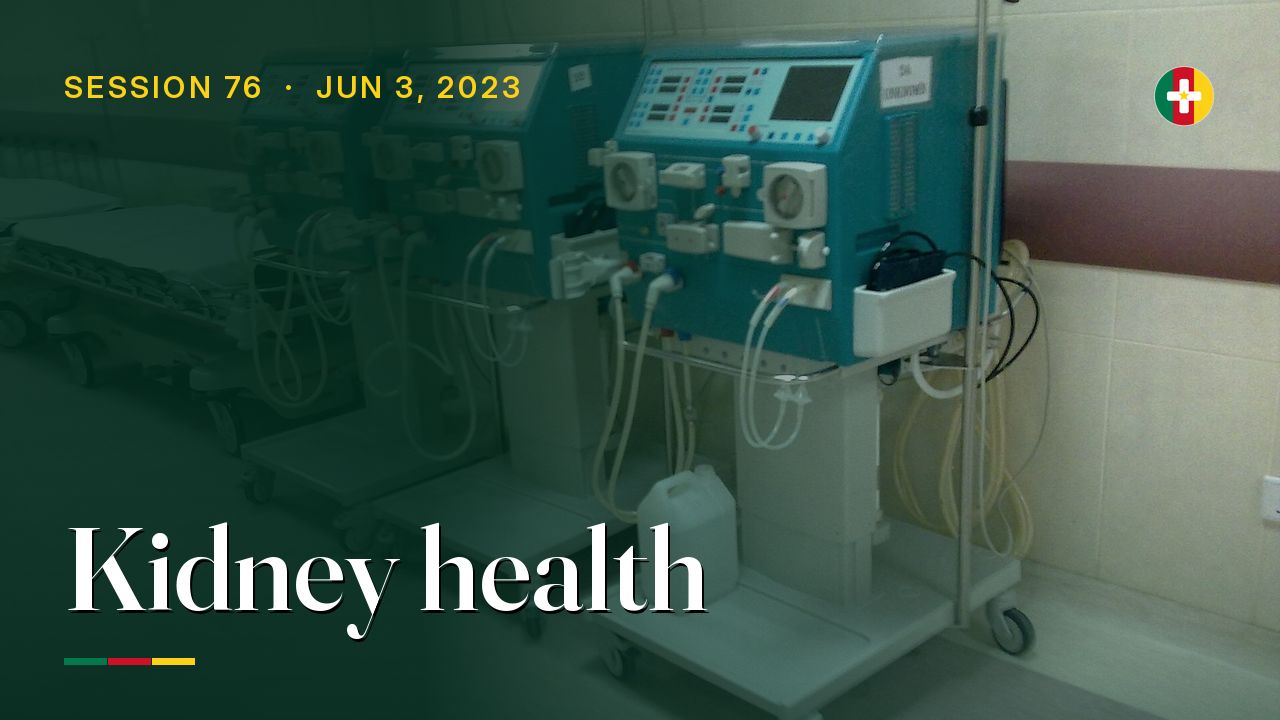
This policy briefing synthesizes key insights from the Cameroon Townhall for Healthcare Professionals meeting held in June 2023 (76th edition), focusing on the theme “Promoting CKD Education, Early Detection and Organ Donation,” presented by Iya Bekondo-Granatella, founder of the Iya Foundation and its Kidney Resource Center in Buea.
Context
CKD is rising in Cameroon and increasingly affects people under 45. Most patients are diagnosed only when they need dialysis. Dialysis in Buea faces supply shortages, disrupted sessions, untrained staff for donated machines, chronic anaemia without affordable erythropoietin or reliable blood supply, and high costs for food, transport, housing and labs. Kidney transplantation remains rare. The speaker, herself a transplant recipient on dialysis, described a patient-centred model built around these gaps.
Key issues
- Late diagnosis. Limited routine testing means CKD is usually found at end stage. Hypertension and diabetes, the two main causes cited, are often first detected at community screenings.
- Costs beyond the dialysis session. Even where sessions are subsidised or covered under Universal Health Coverage, patients pay for vascular access, labs, anaemia treatment, food, transport and lodging. The speaker said UHC rollout in Buea still left confusion over what patients must pay.
- Blood supply for dialysis patients. Chronic anaemia is common, erythropoietin is out of reach for most, and families often seek donors at the last minute. Blood storage, component separation and pooling rules limit what NGOs can do.
- Transplant capacity. HLA typing, post-transplant care and steady immunosuppressant supply are not yet in place, and few Cameroonians register as organ donors.
- NGO and Ministry engagement. The Foundation works well with Buea Regional Hospital, the dialysis clinic and the regional delegation, but had no channel to the central Ministry. Donated equipment went unused and a discounted lab service was blocked locally.
Discussion highlights
- Patient-led organisations see needs (food, housing, mental health) that clinical programmes miss.
- Point-of-care creatinine and eGFR testing can widen screening but should be validated locally.
- Transplantation is possible in Cameroon with HLA typing, trained staff, generic immunosuppressants and a donor culture.
- Red cell concentrates stored correctly would last longer than whole blood and serve more patients.
- More local research is needed on why CKD is rising among young Cameroonians.
Recommendations
- Build CKD screening into routine care. MINSANTE and regional delegations should add creatinine or eGFR and urine testing to the follow-up of hypertensive and diabetic patients in district hospitals. First step: a pilot in the South West with Buea Regional Hospital and community partners already screening there, with local validation of the point-of-care device against laboratory results.
- Clarify what UHC covers for kidney patients. MINSANTE should publish clearly what dialysis patients pay under Universal Health Coverage, and assess extending cover to vascular access, monthly labs and anaemia treatment. First step: a written circular to dialysis centres, starting with Buea.
- Secure blood for dialysis patients. MINSANTE, the national blood transfusion services and regional hospitals should support component separation and red cell storage, and allow NGO-led donor drives to feed a shared, replenished stock. First step: a model MOU between Buea Regional Hospital and the Iya Foundation and Lifeline project.
- Prepare a national transplant pathway. MINSANTE, with university hospitals and diaspora transplant specialists, should plan HLA typing capacity, technician training, a generic immunosuppressant supply, and an organ donor awareness campaign. First step: a public report on the status of transplants done in Cameroon to date.
- Give patient NGOs a channel to the Ministry. MINSANTE's planned diaspora healthcare committee should include patient-led NGOs, and donated equipment should come with technician training before delivery. First step: invite the Iya Foundation and similar groups to the committee's first meeting.
- Fund research on CKD drivers. Universities, hospitals and diaspora researchers should study CKD prevalence and causes in young Cameroonians, including heat, HIV and medicines, and the outcomes of twice-weekly dialysis. First step: pool existing screening data from Green Campaign events with hospital records.
Next steps
The Town Hall offered to share the Foundation's campaigns with its network. The next meeting was announced for two weeks later.
Conclusion
The session showed that CKD care in Cameroon depends on more than dialysis machines. Early detection, clear coverage, safe blood, transplant capacity and a working link between patient NGOs and the Ministry are needed to change outcomes for kidney patients.
Meeting minutes
Agenda
- Welcome and opening remarks by the moderator, Elvis Ndansi, and the Chair, Dr. Munoh Kenne Foma
- Introduction of the guest speaker by the Chair
- Presentation by Iya Bekondo-Granatella on the programmes of the Iya Foundation
- Reflections by the co-moderators
- Discussion and Q&A, moderated by Dr. Bryan Tegomoh
- Closing remarks and next meeting
- Parking lot discussion
Opening remarks
- Elvis Ndansi opened the 76th edition of the Cameroon Town Hall and noted that the platform had reached about 1,800 participants across 37 countries, meeting every fortnight.
- The Chair described dialysis as having once been a death sentence in Cameroon and noted continuing problems of access, cost, and non-functional equipment. He warned against 'parachute medicine', where foreign teams perform transplants and leave without local follow-up care.
- Elvis Ndansi noted that CKD affects about 10% of people globally and that in Cameroon a growing share of patients are under 45. He compared costs he had heard in Kinshasa (about USD 150 per haemodialysis session) with the subsidised cost in Cameroon.
- The Chair urged Africans at home and abroad to register as organ donors, noting that the wide genetic diversity of African populations makes HLA matching harder when donor pools are small.
Presentation
1. About the Iya Foundation
The Iya Foundation is a New Jersey 501(c)(3) non-profit founded in 2011 that works through kidney health education, awareness, early detection, prevention and research, and raises funds for kidney failure patients and dialysis clinics. Its registered branch in Cameroon is the Iya Foundation Kidney Resource Center in Buea, opened in 2019, from which programmes in Cameroon are managed. Its stated missions include reducing the prevalence, incidence and mortality of CKD and end-stage renal disease (ESRD) in Cameroon and highlighting the plight of kidney patients.
2. The speaker's own story
Ms. Bekondo-Granatella was born and raised in Limbe and was diagnosed with nephrotic syndrome at age seven, later confirmed as focal segmental glomerulosclerosis. She did about five years of peritoneal and haemodialysis before a transplant from her mother in 2005, at age 23, which lasted about 16 years. She returned to dialysis in October 2021, three sessions a week, and was awaiting a second transplant at the time of the session.
3. Problem statement
The speaker described CKD and ESRD as a growing public health burden in Cameroon, with frequent supply shortages, insufficient treatment and disrupted dialysis sessions. Because routine annual testing is limited, most patients are diagnosed only when they already need dialysis. Most ESRD patients she works with live at poverty level and struggle to sustain treatment.
4. Green Campaign and community screening
The Green Campaign, started in 2012, runs every March around World Kidney Day with screenings, seminars, media tours and a kidney walk, and has covered the South West, Centre, Littoral and North West regions. In March 2023 it reached six communities including three high schools, screened about 597 people, reached about 75,296 people on Facebook and drew about 425 walkers in Buea. With the Grey Lab it used a point-of-care device that gives creatinine and eGFR on the spot. The speaker estimated about 7.5 million FCFA spent on the campaign from 2020 to 2023, and about 534,000 FCFA on year-round community screenings since 2021.
5. Food Security Programme and Genesis Fund
Begun in 2020 after the team found that dialysis patients in Buea could not afford a renal diet, the Food Security Programme gave quarterly staple foods and nutrition education to 60 to 70 patients per edition over 10 editions, at about 4.1 million FCFA, with vegetable donations from Greenhouse Ventures. It paused after March 2022 for lack of funds. The Genesis Fund, started in January 2021 and named after a patient who died without access to dialysis, paid for dialysis for 11 patients (about 1.8 million FCFA) and one vascular access procedure. In 2017 the Foundation paid about 8 million FCFA for vascular access surgery for about 15 patients at Buea.
6. Mental health and patient engagement
The speaker said almost all dialysis patients in Cameroon struggle with depression and anxiety linked to diet limits, unemployment, insomnia, cost, chronic anaemia and fear of supply breaks. The Foundation's counsellor runs individual and group therapy, weekly ESRD education at the Buea dialysis clinic, and monthly support groups (29 sessions, about 12 patients each). About 60 patients and caregivers benefit weekly from group counselling, and seven patients have told their stories publicly through the 'Humans of Kidney Village' series.
7. Pipeline projects
Planned projects included a Blood Donor Safety Project with the NGO Lifeline and Buea Regional Hospital (one-year estimate 4.6 million FCFA, first year funded by an association of Cameroonian physicians in the United States), emergency housing for displaced dialysis patients who travel long distances or sleep in the hospital (three-year estimate 27 million FCFA), an NCD follow-up programme in a community where many high-risk people were found (about 2.3 million FCFA), and a post-campaign laboratory reassessment of high-risk participants (about 200,000 FCFA).
8. Funding, partners and lessons
The speaker said most funding came from public donations and her own contributions, with smaller shares from sponsors and partnerships. Partners named included the Buea dialysis patients' association, the Ministry of Public Health, the South West Regional Delegation of Public Health, Buea Regional Hospital, the Grey Lab, My Kidney My Life Foundation, and student associations in Buea. Five donated dialysis machines (valued at over USD 70,000) went unused at Buea because technicians were not trained on them, and a plan to run discounted monthly labs for dialysis patients at the Resource Center was blocked by local administrators.
Discussion and Q&A
- Elvis Ndansi asked how engaged the Ministry of Public Health and nephrologists were with the Foundation's work. The speaker said the Foundation has working MOUs with the director of the Buea dialysis clinic and the director of Buea Regional Hospital and sends monthly activity reports to the South West Regional Delegation of Public Health, but had not obtained significant support from the Ministry at central level despite several attempts to meet the Minister. Elvis Ndansi said the Minister had announced a committee for diaspora healthcare professionals, awaiting clearance from the Prime Minister's office, meant to give organisations like hers access to the Ministry. Dr. Katte noted that the regional MOUs already link the Foundation to the Ministry through the normal reporting chain.
- Henry asked whether more could be done on kidney transplantation in Cameroon, since dialysis patients need it and big families mean donors should be available. The Chair said transplantation is feasible but needs government engagement, local HLA typing by trained technicians, and reliable, affordable generic immunosuppressants, rather than imported surgeons. He said clinical and anatomic pathology in Cameroon is still rudimentary and that Africans at home and abroad rarely register as donors, which needs a cultural shift. He recalled that one living-donor transplant had been done in Cameroon in the previous year or two, with no public update since.
- The Chair asked how the blood donation project would work and how the Foundation provides mental health care. The speaker and Jude explained that the Foundation and Lifeline will run sensitisation, register donors, and hold collection days at Buea Regional Hospital, which will screen and store the blood and keep 30% of the stock. The first year is funded.
- Sam asked how blood would be stored given electricity problems, whether donors would be compensated, and what restrictions stop patients from doing labs at the Resource Center. Jude said storage is the main challenge: the hospital blood bank offered a dedicated storage unit for dialysis patients but would not pool and recycle the blood, so unused blood may expire after about 35 days. Donor motivation is in the budget. The Chair added that separating red cell concentrates would allow storage for about 42 days at about 6 degrees Celsius and that this needs Ministry-level advocacy. The speaker said administrators restricted patients from using the Resource Center lab, and that she had been told some clinicians had interests in private laboratories.
- Dr. Katte asked whether the point-of-care creatinine device had been validated against standard laboratory serum creatinine. Elvis Ndansi said the device, made by Nova Biomedical, is CE certified and was validated with samples including from South Africa, and that a pilot protocol had been written with a nephrologist at Buea Regional Hospital. The speaker said the post-campaign follow-up will compare point-of-care results with laboratory results, and that earlier campaigns used urine dipsticks.
Calls to action and closing
- Dr. Bryan Tegomoh called for more research between hospitals, universities and research organisations on the epidemiology and risk factors of CKD in Cameroon to guide policy.
- Elvis Ndansi offered the Town Hall's platform to share the Foundation's campaigns and noted research on non-traditional drivers of CKD in LMICs, including heat and dehydration among outdoor workers and long-term medicines such as antiretrovirals.
- Dr. Katte asked that point-of-care devices made abroad be validated locally, given differences in temperature and altitude.
- The speaker raised a question for researchers: how patients in Buea manage on two dialysis sessions a week when three is the minimum standard in the United States. This was held for the parking lot.
- The Chair recalled his own research in the North West showing HIV, hypertension and diabetes as leading causes of CKD, and appealed to participants to partner with the Iya Foundation.
- Elvis Ndansi closed the session and announced the next meeting in two weeks.
Next meeting
In two weeks.
Submitted by the Co-Moderators, Cameroon Town Hall for Healthcare Professionals.