Student-Led Community Health: Supporting CAMESA and the Next Generation
Overview
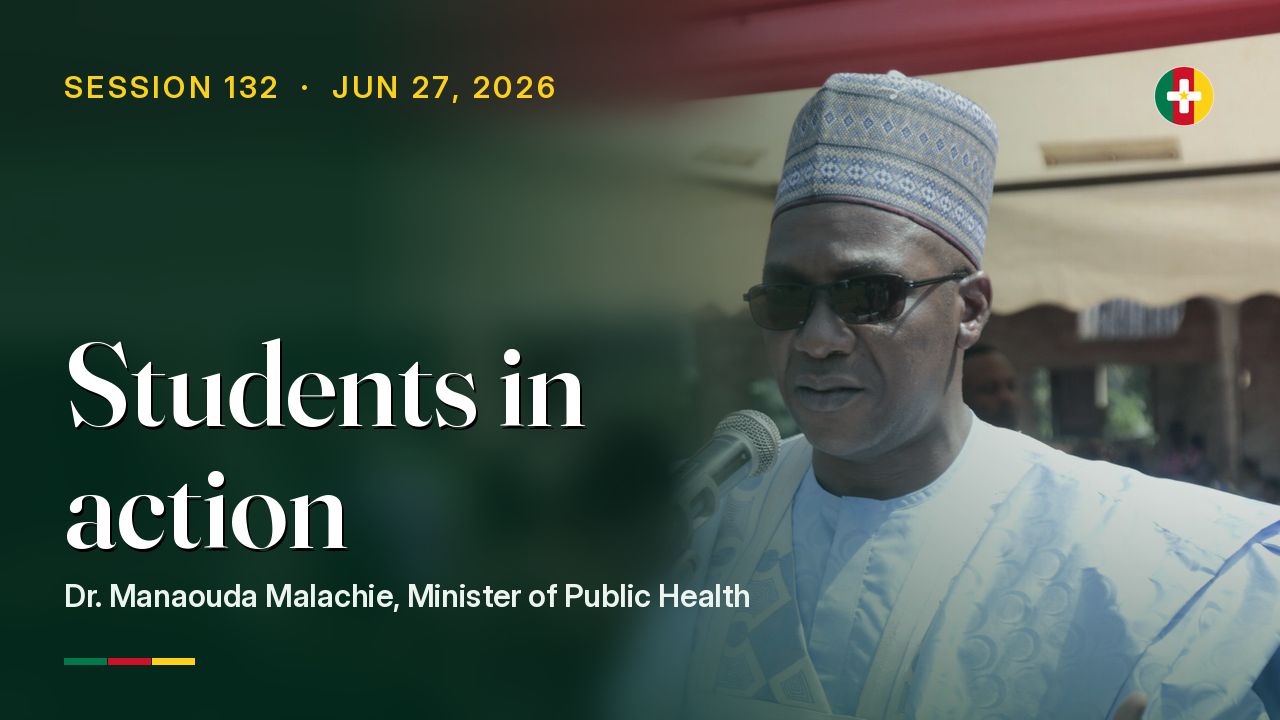
This policy briefing synthesizes key insights from the 132nd session of the Cameroon Town Hall for Healthcare Professionals, held on June 27, 2026, with the Cameroon English Speaking Medical Students' Association (CAMESA) and His Excellency Dr. Manaouda Malachie, Minister of Public Health.
Context
CAMESA has run annual campaigns since 2003 in underserved and crisis-affected communities of the North West and South West, reporting over 28,000 patients seen. Its 2026 campaign in Kupe Muanenguba targeted about 1,500 people, mainly internally displaced, with a funding gap of 7,872,975 FCFA.
Key issues
- Funding. Campaigns depend on yearly fundraising from alumni and partners.
- Follow-up. Patients found during a one-week campaign need a place to continue care.
- Customs barriers. Donated equipment, such as retired laboratory instruments, is held up at customs.
- Recognition. Student initiatives had no formal link to national programmes until the Minister's announcements.
Discussion highlights
- The Minister announced annual community health innovation awards from 2027 and a collaboration framework with CAMESA and the town hall.
- About 89% of the population lives within 60 minutes of a facility, according to Prof. Sobngwi.
- Members pledged cash, equipment, follow-up care and internships during the session.
- Speakers agreed that follow-up and work through district medical officers are what make campaigns last.
Recommendations
- Publish the award rules early. MINSANTE should publish criteria, categories and timelines for the 2027 community health innovation awards, open to all student associations. First step: a call for entries with merit-based scoring and reporting standards.
- Formalise the collaboration framework. MINSANTE technical services, CAMESA and the town hall should sign a framework linking student campaigns to district health plans, surveillance and national programmes. First step: a standard data sheet so campaign findings reach the district health information system.
- Build follow-up into every campaign. CAMESA, district medical officers and partner facilities (such as Premier Health Centre and CLEAR Radiology) should agree referral pathways before deployment. First step: a referral register for the Kupe Muanenguba campaign shared with the district.
- Clear the path for donated equipment. MINSANTE's directorate of health operations should publish the procedure for customs exoneration of donated medical equipment and match donations to facility needs, including reagent supply. First step: a single contact point on the Ministry's diaspora platform.
- Sustain student campaigns. Diaspora professionals, alumni and the town hall should give multi-year support to CAMESA and similar associations, conditioned on the transparent reporting CAMESA already provides. First step: a published post-campaign report and accounts for 2026.
Next steps
The 2026 CAMESA campaign was scheduled for August 2026 in Kupe Muanenguba division, with pledges to be transferred by July. MINSANTE was to set up the collaboration framework and launch the innovation awards in 2027. ACPA planned to present its Buea cancer report to the Ministry.
Conclusion
The session showed students already delivering care where it is scarce, a Minister ready to recognise them, and a diaspora willing to fund and equip them. Follow-up, clear rules and steady funding will decide how much of this lasts.
Meeting minutes
Agenda
- Welcome by the moderators and the Chair
- Opening remarks by His Excellency Dr. Manaouda Malachie, Minister of Public Health
- Reactions to the Minister's remarks (moderators, Dr. Kenji, Dr. Fokam, Prof. Sobngwi)
- Presentation by CAMESA on its history and the 2026 health campaign
- Comments and pledges from members
- Closing remarks by the moderators, the Chair and the Minister
Opening remarks
- Elvis Ndansi said the town hall had about 2,700 members in 37 countries, had existed five years without missing a session, and that each session is viewed by more than 3,000 people. He introduced CAMESA, founded in 1993, whose annual health campaign began in 2003 and has reached 28 health districts and more than 25,000 people; its last campaign, in Bamboutos, served 826 people with more than 100 young medics.
- Dr. Tegomoh recalled the town hall's origins and said its model had been copied in other countries, including India.
- The Chair thanked the Minister, attending unannounced for the fourth time, for his support to ACPA's cancer mission in Buea, and said more than 100 medical, pharmacy, dentistry and laboratory students were following from one amphitheatre because of internet problems.
Presentation
1. The Minister's announcements
The Minister congratulated CAMESA and all students engaged in community health. He announced Ministry of Public Health annual community health innovation awards starting in 2027, which will recognise the best student-led initiatives on national priorities and give them technical support, mentorship and links with development partners. He instructed his technical services to build a collaboration framework with CAMESA and the town hall so that student initiatives feed national programmes in prevention, health promotion, surveillance and primary health care.
2. Access and equipment
Prof. Sobngwi said health districts had grown from about 150 to almost 220, and that about 89% of the population now lives within 60 minutes of a health facility, against about 60% before. Elvis Ndansi said the Minister had offered to facilitate diaspora donations of medical equipment, up to exoneration from customs duties. Dr. Kenji said he had a working sequencer retired from Stanford in his garage and that customs had always been the obstacle; Dr. Fokam offered to help the directorate of health operations fast track exonerations for biomedical equipment and suggested a position paper on the town hall as a model.
3. Who CAMESA is
Dr. Lamuela Chin said CAMESA, the Cameroon English Speaking Medical Students' Association, was founded in 1993 in Yaoundé as an apolitical non-profit with the motto 'Unity, Solidarity, Progress'. A general assembly elects officers annually in November by secret ballot under an independent electoral committee, and every payment requires three signatures (president, treasurer and financial secretary). Outside the campaign, members hold monthly assemblies, tutorials, school and hospital sensitisation, and visits to orphanages, nursing homes and prisons.
4. Thirty years of campaigns
The first campaign was in 2003 in the North West, expanding to the South West in 2006. Surgical interventions were added by 2011, laboratory screening for malaria, HIV, STIs, diabetes and typhoid between 2014 and 2016, a partnership with an eye institute in 2017, and work with internally displaced people from 2019, continuing through the crisis years. Since 2024 the team makes four scouting visits before each campaign. She cited more than 20 campaigns, over 28,000 patients seen, and partners including ASCOVIME, the CHAI Foundation and the Cameroon Town Hall.
5. The 2026 campaign
The 2026 campaign was set for August 9 to 16, 2026, in a health district of Kupe Muanenguba division (Nguti), targeting about 1,500 people with a focus on internally displaced people. More than 120 personnel were planned: over 20 doctors, at least five surgeons, 10 dental surgeons, two ophthalmologists, eight pharmacists, 10 laboratory scientists, over 20 nurses and midwives and over 40 students. Services include general and dental consultations, eye care, laboratory screening, surgery by partner teams, free medicines, and daily health education on hygiene, water safety, HIV, sickle cell disease, cervical cancer and child nutrition. Follow-up relies on district medical officers, community health champions and annual return.
6. Budget and the ask
The total budget was 10,872,975 FCFA, with 7,872,975 FCFA still to be raised, to cover supplies, reagents, transport, lodging and food for the team, the last scouting trip, education materials and a contingency fund. Pledges were requested by July 2026. Donors would receive recognition, real-time updates, a post-campaign report and an invitation to the virtual launch on August 9.
Discussion and Q&A
- Elvis Ndansi asked the Minister to react to the presentation. The Minister reacted to the presentation and made a personal contribution; Elvis Ndansi thanked him for it and for the innovation award.
- Pledges from members Prof. Fobi pledged 500,000 FCFA. The Chair pledged 1,000,000 FCFA on behalf of the town hall, citing the detailed accounting of last year's grant. Dr. Kenji pledged 500,000 FCFA and laboratory expertise. Prof. Ngatchu pledged 100,000 FCFA and free follow-up at Premier Health Centre in Douala for patients with digestive conditions referred by CAMESA. Dr. Ndinjiakat pledged 100,000 FCFA, an ECG machine for students, medical supplies from an incoming container, and internships at a clinic near Yaoundé (Awae). Sidney Tazeh pledged 200,000 FCFA and rotations at CLEAR Radiology. A member from Georgia pledged anonymously.
- Prof. Ngatchu: what should CAMESA add? He said bringing care within an hour of most people is the foundation of universal health coverage, urged the diaspora to highlight positive experiences, and asked CAMESA to set up follow-up for every patient treated, since half treating someone is worse than not treating.
- Dr. Fokam (lecturer, University of Buea): testimony He said CAMESA had improved community awareness and adherence to health policy in the South West despite the crisis, and urged students to compete seriously for the Minister's merit-based award.
- A participant: why do campaigns matter? He said outreach often finds people who have not had a blood pressure check in five years and are unknowingly hypertensive, so campaigns also prompt regular check-ups.
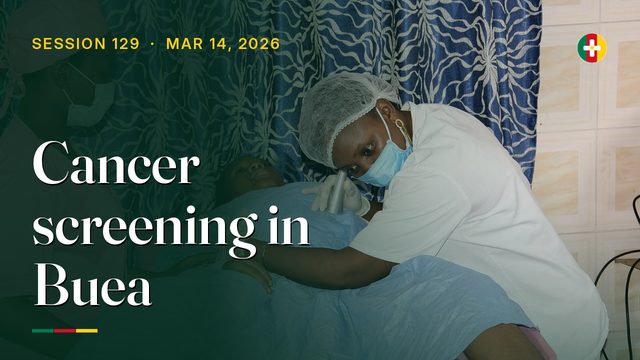
- The Chair on the ACPA mission He said ACPA had screened more than 2,000 people for cancer in Buea, was preparing proposed screening guidelines with the Ministry, and was working on the national cancer registry and harmonised tumour boards. He stressed that campaigns must work through district medical officers and existing facilities so patients are followed up.
Calls to action and closing
- Dr. Tegomoh offered technical support to the students for the campaign and their careers.
- The Chair said Prof. Alan Tita was among CAMESA's founders, recalled his own CAMESA campaigns around 2002, and urged students to make their projects sustainable.
- The Minister closed: 'hospitals treat disease but communities build health', calling the students the builders of tomorrow's Cameroon and pledging that the Ministry would stand by them and remain open to diaspora projects.
- Elvis Ndansi thanked the Minister and CAMESA and called for continued mentorship and collaboration.
Submitted by the Co-Moderators, Cameroon Town Hall for Healthcare Professionals.