Strengthening Cameroon's Health System: Lessons from the WHO Building Blocks
Overview
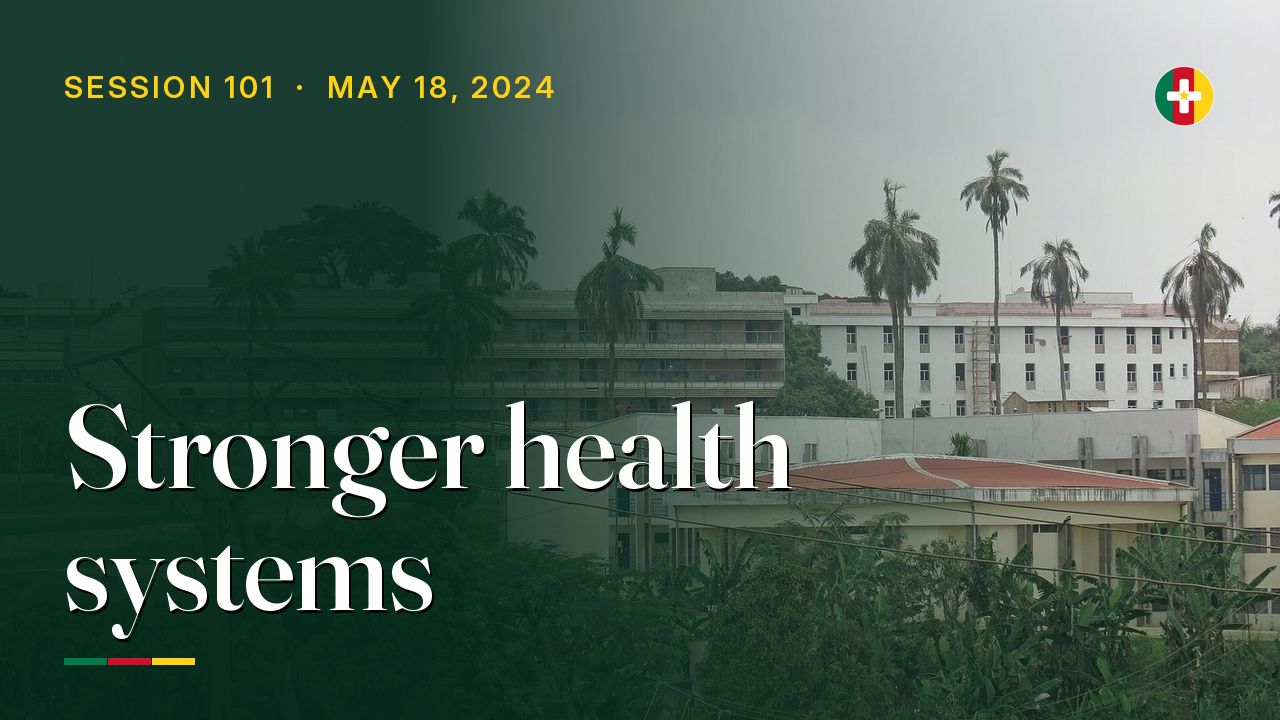
This policy briefing synthesizes key insights from the Cameroon Townhall for Healthcare Professionals meeting held on May 18, 2024 (101st edition), focusing on the theme "Cameroon's Health Ecosystem through the WHO Framework for Health System Strengthening," presented by Dr. Bryan Tegomoh.
Context
Cameroon holds unspent funds from the COVID-19 period earmarked for health system strengthening. The session reviewed the system against the WHO's six building blocks and gathered the views of diaspora and in-country professionals on where effort should go first.
Key issues
- Financing and dependency. Health spending was put at under 4%, far from the 15% Abuja commitment. Care is largely paid out of pocket, only about 2% of people have private insurance, and key commodities depend on the Global Fund.
- Supply chain. Weak demand forecasting, procurement, warehousing and distribution, unpaid suppliers at the national procurement agency, and donated medicines held at port awaiting duty waivers.
- Workforce. Shortages and urban concentration of staff, brain drain, poor incentives, and training of doctors without the auxiliary staff they need. Community health workers lack legal status.
- Health information. Fragmented, largely paper based data, limited analytic capacity, and slow delivery of the 2020 to 2024 National Digital Health Strategic Plan.
- Governance, trust and politics. Low public trust in how taxes are used, health treated as the business of the Ministry alone, and limited political will.
Discussion highlights
- Participants agreed governance and financing are linked: new taxes will not be accepted without transparency.
- Proposals included a diaspora health fund drawing on remittances and taxes on alcohol and luxury goods.
- Speakers called for community health workers to be given legal status and a stronger preventive and primary care focus.
- Barriers to diaspora engagement were raised: dual nationality, visas and money transfer rules.
- Communities are already funding facilities and paying staff through village health committees.
Recommendations
- Raise and protect health financing. MINSANTE and the Ministry of Finance should publish a costed path towards the Abuja 15% target and report health spending openly. First step: publish how the remaining COVID-era health system strengthening funds are allocated across the six building blocks.
- Give community health workers legal status. MINSANTE should define the status, scope of practice and protection of community health workers, including the right to carry and give approved medicines, so that people living far from facilities are reached. First step: a ministerial text recognising them, shared with regional delegations and security services.
- Fix procurement and distribution. MINSANTE, the national procurement agency and partners should clear supplier arrears, improve demand forecasting and set fast-track customs clearance for donated medicines. First step: an audit of arrears and a joint MINSANTE and Ministry of Finance protocol for duty waivers.
- Deliver the digital health plan. MINSANTE should report on the 2020 to 2024 National Digital Health Strategic Plan and move district and hospital records from registers to electronic systems, drawing on diaspora data and surveillance specialists. First step: a status review of the plan and a pilot in one region.
- Make diaspora engagement easier. The ministerial committee for diaspora engagement and the Ministry of External Relations should complete the interim identification for diaspora health professionals and simplify transfers for registered health projects. First step: share the town hall survey results with the committee.
- Work across sectors. MINSANTE should involve the ministries of finance, women's affairs and external relations in health priorities, with a high-level coordinating body for malaria as a test case.
Next steps
The town hall will deploy its participant survey and share results; future sessions will take each building block in turn, starting with health financing with a specialist speaker. The next session, on liver cancer, was set for two weeks later.
Conclusion
Participants agreed that Cameroon has much of the structure a strong system needs, but financing, supply chain, workforce and data gaps hold it back, and that trust and governance shape all of them. Small, concrete steps within reach, backed by sustained advocacy, are the town hall's chosen route.
Meeting minutes
Agenda
- Welcome and opening remarks by the moderator, Elvis Ndansi, and the Chair, Dr. Munoh Kenne Foma
- Presentation by Dr. Bryan Tegomoh on Cameroon's health ecosystem and the WHO framework for health system strengthening
- Announcement of the Cameroon Town Hall participant survey
- Discussion and Q&A
- Closing remarks, announcement of the next topic and adjournment
Opening remarks
- The moderator welcomed participants to the 101st edition of the Cameroon Town Hall, the first session after the 100th edition, dedicated to health system strengthening using the WHO framework.
- Dr. Tegomoh said his goal was to see the town hall model replicated in other African countries, so that each country's diaspora health professionals could contribute to development at home.
- The Chair said Cameroon needs a health system that is patient centred, result based, accountable and cost effective, and invited participants to reflect on prevention, health promotion and protection, leadership and governance, financing, human resources, inventory, infrastructure and health intelligence.
- The moderator noted that funds given to Cameroon by the World Bank or IMF during COVID-19 were meant for health system strengthening and, to his knowledge, were still being programmed. He said the policy brief from this session would be shared with stakeholders implementing that project, and asked how a WHO framework fits with a country's own national framework.
Presentation
1. Purpose and structure of the health system
Dr. Tegomoh said the topic grew out of the previous session's call for a needs assessment of Cameroon's health ecosystem. He described a system of public, private and traditional providers, with the Ministry of Public Health at the top, regional delegations of health beneath it, then district health services, central and general hospitals and peripheral facilities. He stressed that generating data is not enough: solutions must be formulated, adapted and implemented.
2. Main health challenges
He listed the high burden of infectious disease (malaria, HIV, TB) and weak surveillance, persistent maternal and child health problems, limited access to care in rural areas, and a shortage of health workers. Most new graduates prefer urban posts, leaving peripheral hospitals short staffed, and brain drain continues.
3. The six WHO building blocks applied to Cameroon
He presented the WHO framework's six components: leadership and governance, health financing, human resources, information systems, service delivery, and access to essential medicines. Primary care runs through health centres and district hospitals but suffers from inadequate infrastructure and equipment in rural and urban areas alike. He described community health programmes and community health workers as a viable route to sustainable strengthening. He cited a 2020 paper that mapped training gaps in Cameroon across policy and planning, management, human resources and data functions (standards, client and facility data, data quality and analysis) and recommended it to participants.
4. Health information systems
He said data systems remain fragmented, analytic capacity is limited and many records are still kept in paper registers. Recalling his work around 2014 to 2015 with the CDC country office on maternal health reporting, he said data had to be abstracted by hand even in major Yaoundé hospitals. He noted that diaspora Cameroonians have the expertise to build surveillance systems, but internet access in rural areas remains a constraint.
5. Medicines, financing and governance
Access to essential medicines is held back by supply chain problems at the national procurement body in Yaoundé, and the country relies on the Global Fund for vital commodities. Health care is still financed largely out of pocket. He recalled the Minister's earlier town hall discussion of universal health coverage and commended the Ministry for moving in that direction. He called for policies against corruption, accountability, stakeholder trust, and the engagement of community, religious and traditional leaders, whom he called the most underappreciated influence on any health system.
6. Integration of the WHO framework and national documents
He said Cameroon has begun integrating the framework into policy, with documented gains in maternal and child health (antenatal care in rural areas, skilled birth attendance, emergency obstetric services, community health workers), supported by partners such as the Global Fund and PEPFAR. He recommended the WHO Cameroon Country Cooperation Strategy and the Ministry's 2020 to 2024 National Digital Health Strategic Plan, while noting that by mid 2024 little of the plan's vision had been put into action.
7. Innovation and partnership
He cited telemedicine and mobile health, including the GiftedMom texting service for antenatal care presented at an earlier session, public private partnerships, and community based health insurance on the model of the njangi. He named WHO, the Global Fund, CDC and UNICEF as key partners for funding, technical assistance and capacity building.
8. Recommendations and the participant survey
He closed with recommendations on workforce training and retention, supply chain management, innovative financing, transparent leadership and universal health coverage, and noted political instability in the North West and South West regions and wide health disparities. He announced a short anonymous survey (under three minutes) to assess the town hall itself and the diaspora's view of Cameroon's most pressing health challenges, to inform the town hall and the Ministry's committee for diaspora engagement.
Discussion and Q&A
- Moderator's reflection (Elvis Ndansi): what does low health spending mean for Cameroon? He said Cameroon spends less than 4% on health, short of neighbours spending around 6% and far from the 15% of the state budget recommended under the Abuja commitment. Many health commodities are procured with Global Fund money, so stock outs and deaths would follow if partners withdrew. He urged citizens to press parliamentarians for budget reform.
- Chair's reflection (Dr. Munoh Kenne Foma): how is health financed and can universal health coverage be sustained? He said only about 2% of Cameroonians have private insurance, so out of pocket spending dominates and a cancer diagnosis can impoverish a family; he cited leuprolide (Lupron) at almost 500,000 per injection. He asked whether general taxation or social health insurance could be reinstated, criticised training doctors without auxiliary staff (for radiation oncology: physicists and dosimetrists), and named demand forecasting, procurement, warehousing and distribution as the biggest weaknesses.
- Prof. Theodore Ngatchu: where are the system's main weaknesses? He said Cameroon has the foundation for a strong system, with every region covered by health districts and district hospitals, and that its main problems are governance, finance and public education. The government already subsidises care but should communicate what it contributes to a far better educated population. Financing care for the needy deserved its own session.
- Dr. Marthe-Sandrine Mpollo: can taxation finance health care? She linked financing to governance and trust, noting a new law (from about June 2024) requiring all Cameroonians, including the informal sector, to file taxes to open a bank account. Without transparency people would feel robbed by another tax. She proposed a health fund channelling part of diaspora remittances and taxes on non-essential goods such as alcohol and luxury items.
- A participant: does the government actually want the diaspora's help? He cited refusals of dual nationality and visa difficulties, around 52 child deaths per thousand, and about 0.8 to 1.2 health workers per 1,000 people. The moderator replied that passports of some civil servants were being seized at the airport, which he called the wrong approach, and that the ministerial committee was working on an interim identification to ease travel for diaspora health professionals while dual nationality awaits Parliament. The Chair said recorded remittances are about 0.8% of GDP, against about 7% for Nigeria and 8% for Egypt, and recalled that Cameroon stopped training midwives for about 20 years from 1988.
- Dr. Wirngo Mohamadu Suiru: what is missing from the framework? He proposed adding politics as a pillar and building politicians' capacity on health priorities. He said the Ministry focuses on curative care at the expense of primary care, that community health workers have no legal status and are sometimes harassed by police for carrying medicines, and that over 50% of the population in some areas lives more than 10 km from a facility. Later he called for multisectoral collaboration, citing Global Fund medicines held at the port for six months awaiting a duty waiver, and the idea of a malaria council at prime ministerial level.
- Dr. Obadia Mfuh Kenji: why does change not happen? He said political will and corruption are systemic and that offers of expertise from the diaspora are often met with indifference at home while other countries seek them out. He called for a change of mindset rather than more regulations.
- Prof. Theodore Ngatchu: what blocks diaspora investment? He said no UK bank does direct transfers to Cameroon and moving money in or out needs approvals up to the central bank, so much of the money spent on health projects goes unrecorded. He urged the diaspora to work with existing structures and improve them. The moderator added that outbound payments can take about three months through an intermediary bank in Paris.
- A participant: what are communities already doing? He noted that communities fund and build health facilities and recruit staff, and the moderator described village health committees that pay health staff in some facilities.
Calls to action and closing
- Dr. Tegomoh thanked participants and said the WHO framework offers a road map for collective action on governance, workforce, community and partner engagement.
- The moderator proposed future sessions on each building block, and on health financing with a specialist speaker.
- The Chair stressed preventive medicine, citing Cuba, and the shift in disease burden from infectious to non-communicable disease, and urged all participants to complete the survey.
- The survey was to be sent by email during the following week.
- The next session was announced on liver cancer (hepatocellular carcinoma), including alcohol, hepatitis B and hepatitis C.
Next meeting
In two weeks: Liver Cancer in Cameroon (June 1, 2024 per the town hall's records).
Submitted by the Co-Moderators, Cameroon Town Hall for Healthcare Professionals.