Building Implementation Science in Cameroon
Overview
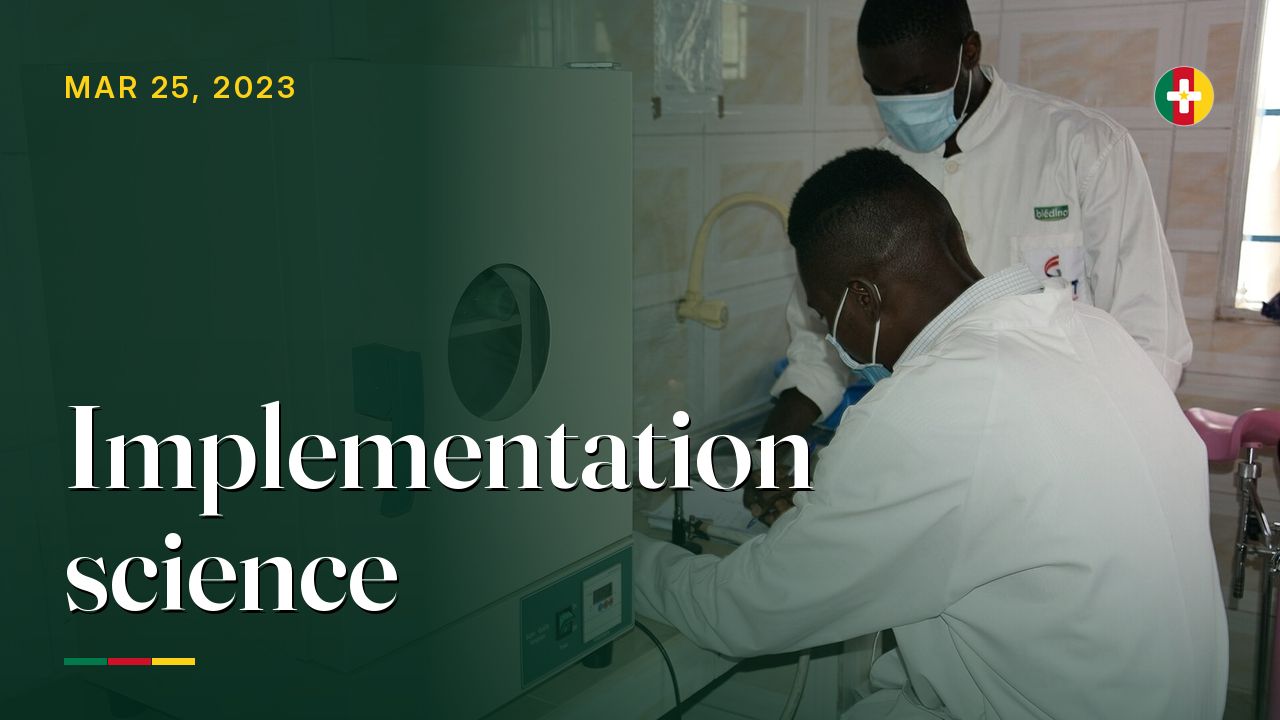
This policy briefing synthesizes key insights from the Cameroon Townhall for Healthcare Professionals meeting held on March 25, 2023, focusing on the theme "Challenges and Opportunities in the Practice of Implementation Science in Cameroon", presented by Dr. Ferdinand C. Mukumbang of the University of Washington.
Context
Implementation science studies how proven interventions are taken up into practice and policy. A scoping review found no implementation science studies from Cameroon, while Nigeria, South Africa and Kenya led in Africa. Participants pointed to low government research funding, slow ethics review and weak links between researchers and policymakers, while noting Cameroon's own contributions, such as the NAMSAL HIV trial.
Key issues
- Evidence not reaching practice. Proven interventions, from COVID-19 vaccines to bed nets, see poor uptake when acceptability and context are not studied.
- Gap between researchers and policymakers. Policymakers in Cameroon reported evidence as unavailable, inaccessible or not applicable, and evidence-informed decision making was less understood than in South Africa.
- Unfriendly research environment. Slow ethics clearance, little public research funding and low health spending (under 5 percent of the budget, as stated) push partners toward other countries.
- Research quality and integrity. Weak thesis supervision, unpublished findings and concerns about management of grant funds undermine trust.
- Low visibility of Cameroonian research. Work done in Cameroon is not communicated, so the country is absent from regional networks and funders' priorities.
Discussion highlights
- Hybrid type 3 studies were recommended to test interventions proven elsewhere in Cameroonian settings.
- Kenya and South Africa attract research through policy, not wealth.
- Cameroon-generated evidence (the NAMSAL trial, intermittent preventive treatment for malaria) shows what is possible.
- Digital ethics review and a free protocol review service were being introduced.
Recommendations
- Speed up and digitise ethics review. MINSANTE and the National Ethics Committee should complete the planned online submission and review portal and publish target turnaround times, starting with the pilot already funded.
- Link research to policy needs. MINSANTE, through its operational research directorate, should publish an annual list of priority implementation questions for universities and partners, and invite researchers to present findings in plain-language briefs to policy teams.
- Fund national priority research. Government should allocate a dedicated research budget within disease programmes such as malaria and HIV, and require implementation and sustainability evaluation of donor-funded interventions.
- Strengthen research training. Medical faculties should require proposal review before thesis work, train supervisors, and teach implementation science and research methods from early years.
- Make Cameroon attractive to research partners. MINSANTE and universities should set clear rules for research collaboration, data sharing and transparent management of grant funds, including fair pay for students and field staff.
- Use the diaspora to raise visibility. Diaspora researchers should co-lead studies with Cameroonian teams, and the town hall should showcase Cameroonian research and send a summary of priorities to the Minister of Public Health.
Next steps
The moderators planned to summarise key challenges for the Minister of Public Health, who had asked to return to the town hall. The DAC-Africa protocol review service was to be launched in Cameroon on May 2, 2023, and the speaker planned to begin research in Cameroon.
Conclusion
Cameroon produces evidence and has researchers at home and abroad, but too little of it moves into practice. A research-friendly environment, closer ties between researchers and policymakers, and contextual studies of what works locally would help close that gap.
Meeting minutes
Agenda
- Welcome and opening remarks by the lead moderator, Elvis Ndansi, and the Chair
- Introduction of the speaker
- Presentation by Dr. Ferdinand C. Mukumbang on "Challenges and Opportunities in the Practice of Implementation Science in Cameroon"
- Discussion and Q&A, moderated by Dr. Christelle Jouego Tagne
- Summary, closing remarks and next meeting
Opening remarks
- The lead moderator said the town hall had recently been focusing on clinical and implementation research, and introduced the speaker as one of the town hall's earliest participants.
- Dr. Tegomoh said he had met the speaker in person in Seattle at the American Society of Tropical Medicine and Hygiene annual meeting in November 2022.
- The Chair, who said the speaker had encouraged him to study medicine, urged members to use the platform to influence policy and practice at home, working alongside government where needed.
- The lead moderator read the speaker's bio: his research centres on retention in care and adherence to antiretroviral treatment, the transition of adolescents living with HIV to adult care, and strategies to decolonise global health, including the inclusion of refugees and migrants in the COVID-19 response.
Presentation
1. Why implementation science exists
Dr. Mukumbang said it takes about 17 years for a clinical innovation to reach practice, only about half of innovations ever reach general use, and about 80 percent of medical research spending does not reach public impact. Implementation science addresses this know-do gap. He cited COVID-19 vaccines, developed in six to nine months against the usual five to ten years, whose uptake in Cameroon was very poor because of rumours that they were meant to sterilise or harm Africans.
2. Definition and place in the research spectrum
Using the NIH definition, he described implementation science as the methods that promote the integration of evidence-based interventions into policy and routine practice. It follows basic, clinical and population health research. Citations and NIH funding for the field grew sharply between 2005 and 2021. He gave the example of a paediatric HIV formulation that worked in the laboratory but was unpalatable and hard to store, so caregivers asked whether it could be mixed into egusi or okra soup, leading to new formulations such as pellets.
3. Barriers, facilitators and strategies
He distinguished the evidence-based intervention (a drug, vaccine or programme) from the implementation strategy used to deliver it. Barriers and facilitators must be understood at the individual, interpersonal, organisational, community and policy levels. Bed nets were his example: proven to reduce malaria, yet many people in endemic areas do not use them. Planning should consider the perspectives of developers and patients, the characteristics of the setting, and the external environment, including culture, politics and finances.
4. Implementation outcomes
He listed the outcomes the field measures: acceptability, adoption, appropriateness (for example tablets for adults and liquids for children), cost (whether government can sustain it without turning to donors), feasibility, fidelity, penetration and sustainability.
5. Hybrid study designs
Hybrid type 1 studies test clinical effectiveness while collecting implementation information, such as user views. Type 2 studies weigh effectiveness and implementation equally. Type 3 studies test an implementation strategy for an intervention already proven effective, while checking effectiveness in the new context. He urged researchers to add implementation questions to their trials.
6. Where Cameroon stands
A scoping review of implementation science research in Africa found no such studies in Cameroon, while Nigeria, South Africa and Kenya led. A qualitative study of Cameroon and South Africa found that Cameroonian policymakers saw research evidence as unavailable, inaccessible (often behind paywalls), ill-timed or not applicable, cited lack of time and capacity, doubted the reliability of online research, and were less familiar with evidence-informed decision making than their South African counterparts.
7. What could change
He called for closer relationships between researchers and policymakers. During his PhD in South Africa the Department of Health had proposed problems for students, and he was later invited to present his findings in plain language and to support the policy design team. He said researchers abroad, himself included, often do not understand how Cameroon's health system and policy process work, and asked the town hall to host an expert on the subject.
Discussion and Q&A
- Dr. Tegomoh said researchers rarely engage policymakers from the start, recalling the previous session's point that about 90 percent of theses at the Yaoundé medical faculty stay on library shelves. Dr. Katte Jean-Claude said research teams exist in Buea, Dschang, Yaoundé, Ngaoundéré and Garoua, though quality varies, and offered to connect researchers abroad with them. Not all research can translate into policy; topics should aim to transform practice, and that requires good supervisors. He cited a young doctor in the North West who studied a problem in his own hospital, as shown at the previous session.
- A malaria PhD researcher said that in 2017 the national malaria programme told him it had no budget for malaria research, that publication fees keep Cameroonian work unpublished, and asked whether the Ministry of Public Health has any research budget or implementation trial centres. Dr. Mukumbang agreed, noting that Cameroonian policymakers question the quality of research while the country lacks its own research centres.
- A participant asked what happens if the clinical and population research behind an intervention is flawed. Dr. Mukumbang said findings are usually replicated, critiqued and pooled in systematic reviews before reaching implementation. The Chair added 'garbage in, garbage out', questioning the supervision and methods of many MD theses and whether proposals are reviewed before students spend their families' money.
- The Chair asked whether implementation science can work in a poor, indebted country with weak infrastructure and coordination, noting that Cameroon spends under 5 percent of its budget on health against a 15 percent commitment, and that the HIV programme nearly collapsed when external funding was not secured. Dr. Mukumbang said political will is the issue. Kenya and South Africa, though not rich, have made their systems attractive to foreign research partners through policy, so evidence produced there is easy to adopt; in South Africa one hospital may host several trials, while one is hard to find even at a major Cameroonian hospital. The malaria researcher added that political appointments over merit weaken programmes.
- Dr. Ivo Ditah asked how Cameroonians can be involved from the outset of research so that results apply to them, and commented on peer review and publication bias. Dr. Mukumbang recommended hybrid type 3 studies in Cameroon to test acceptability and effectiveness locally. He said ethics clearance in Cameroon is slow, and that the time needed to complete one study there, compared with several in South Africa, discourages researchers abroad. He proposed that the town hall send a communiqué to the minister on making Cameroon research-friendly.
- Dr. Tegomoh asked which public health problems would benefit most and how success is measured. Dr. Mukumbang named disease prevention, especially malaria: draining standing water and giving every child seen for malaria a free bed net. South Africa funds HIV care and renegotiates antiretroviral prices each year. Success is measured by whether evidence is taken up into practice or policy, such as WHO's test-and-treat policy for HIV, which he said Cameroon had recently adopted. The Chair added examples of nets used for fishing and wells in the North rejected because women valued meeting at water points; Dr. Mukumbang said this is why contextual and sustainability research is needed.
- The malaria researcher raised research integrity: grant funds diverted to personal use and students paid 25,000 to 50,000 FCFA when budgets allow about 400,000. He called for transparency in collaborations, including direct contact with field staff about how funds are spent.
- Dr. Katte Jean-Claude cautioned against blanket statements that nothing is being done. Dr. Katte cited research generated in Cameroon that changed practice: intermittent preventive treatment for malaria, and the NAMSAL trial of integrase inhibitor-based HIV treatment, which supported WHO's adoption of dolutegravir in first-line treatment in more than 92 countries. Dr. Katte noted strong NCD research, Prof. Rose Leke's role in building malaria research, HIV work by Prof. Charles Kouanfack and others, and a directorate for operational research with little government funding. Dr. Katte said most research funding goes to English-speaking countries, though Mali and Senegal were growing.
- A cardiologist from Dallas who runs a hospital in the North West said Cameroon was absent from a 2018 Harvard summit and from a Sweden-based digital network for cervical cancer elimination. The cardiologist described the hospital distributing bed nets at community rallies and a monthly women's group of more than 400 that encourages HPV vaccination, and said the town hall could help put Cameroon's work on the map.
- A participant asked how operational research differs from implementation science. Dr. Mukumbang said operational research comes from management science and examines an institution's own challenges and facilitators, while implementation science develops methods to move evidence into practice and policy; they overlap but differ.
- Dr. Ivo Ditah asked in the chat how the challenges raised could give the town hall impact. Elvis Ndansi said the moderators would consider summarising key challenges for the Minister of Public Health, who had asked to return. He announced a three-year Clinton Health Access Initiative-supported grant to digitise ethics review in Cameroon through an online portal, and a free protocol review service (DAC-Africa) to be launched in Cameroon on May 2 with a Bill & Melinda Gates Foundation delegation.
Calls to action and closing
- The lead moderator summarised the 17-year gap, the 50 percent and 80 percent figures, and the implementation outcomes, and said many good examples abroad were driven by committed citizens as much as by governments.
- The Chair recalled Cameroonian pioneers, including Prof. Rose Leke in malaria and Prof. Jean-Claude Mbanya, former president of the International Diabetes Federation, and said the country needs an environment that carries such work along.
- Dr. Tegomoh asked members to identify specific areas where implementation science could help, citing a young doctor's hospital study that reduced neonatal sepsis.
- The Chair apologised for the start-time confusion and confirmed that sessions now start at 6 PM Cameroon time and 1 PM Eastern time.
Next meeting
In two weeks (April 8, 2023 expected), 6 PM Cameroon / 1 PM Eastern.
Submitted by the Co-Moderators, Cameroon Town Hall for Healthcare Professionals.