Recognising Autism Early in Cameroon: Screening, Support and Ending Stigma
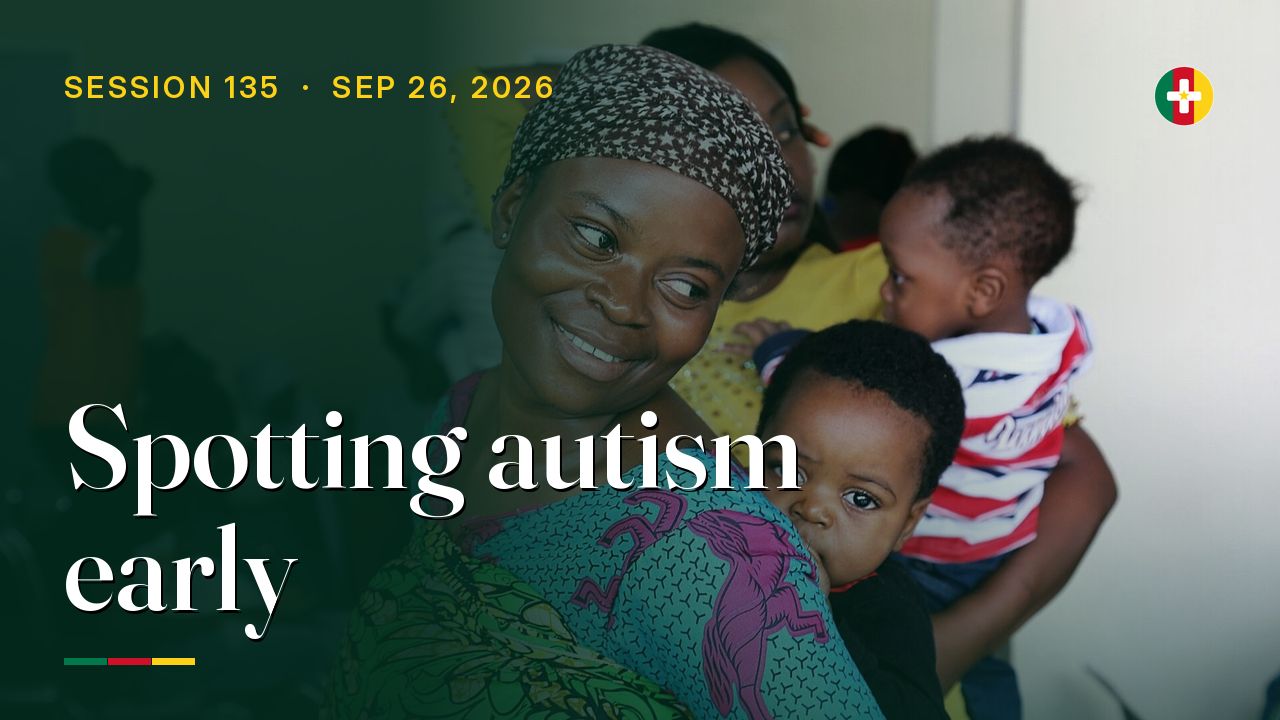
Overview
This brief draws on Session 135 of the Cameroon Town Hall for Healthcare Professionals, held on September 26, 2026. Paediatrician Dr. Lum Frundi gave an update on autism screening and diagnosis, and a mother who founded a support foundation and a paediatrician in Yaoundé described the realities for families in Cameroon.
Context
WHO estimates that about 1 in 100 children worldwide has autism, and the US CDC reports 1 in 31 eight-year-olds in monitored communities. Cameroon has no national autism registry. Participants described autism blamed on witchcraft, children hidden at home, delays as families are told to wait, very few child psychologists, almost no occupational or behavioural therapists, scarce English-speaking speech therapists, high costs, large classes and strained marriages.
Key issues
- Stigma and spiritual explanations. Families and communities attribute autism to witchcraft or bad parenting, delaying care and isolating mothers.
- Missed early signs. Primary care workers are not trained to screen, and families are told to wait for speech.
- No therapy workforce. Cameroon lacks speech, occupational and behavioural therapists and special educators, especially in English.
- Schools not equipped. Classes of 35 to 40 without support staff exclude children with autism.
- Harmful cures and misinformation. Families spend money on unproven or dangerous treatments, and vaccine myths persist.
Discussion highlights
- Dr. Frundi: autism is a brain that develops differently, not a bad child or bad parenting.
- Dr. Frundi: the earlier therapy starts, ideally by 18 months to 2 years, the better the outcome.
- Siri Mambo: at our first outreach, autism was linked to witchcraft.
- Dr. Erica: a Toyota key cannot start a Ferrari; parent the child in front of you.
- A Nairobi paediatrician: train the staff we have as early childhood development champions.
Recommendations
- Add developmental screening to routine child visits. MINSANTE and the Expanded Programme on Immunisation should add simple developmental questions (babbling, eye contact, response to name, pointing, words) to vaccination and well-child visits from 6 to 24 months, with a referral pathway. First step: adapt a screening checklist and train staff in one region, drawing on Kenya's early childhood development champions.
- Train allied health professionals. The Ministries of Public Health and Higher Education should create training programmes for speech and occupational therapists, child psychologists and special educators, in both English and French, with diaspora teaching support.
- Support inclusion in schools. The Ministries of Basic and Secondary Education should train teachers in autism, allow special educator shadows and individual education plans, and pilot inclusive classrooms with support staff.
- Fight stigma with families and communities. Regional delegations, with parent organisations, churches and the media, should run plain-language campaigns in local languages presenting autism as a developmental condition, featuring parents' stories.
- Protect families from harmful treatments. MINSANTE and the medical and pharmacy councils should warn against bleach, chelation and other unproven treatments sold as cures and act against those who sell them.
- Count children with autism. MINSANTE should start a paediatric developmental disorders register in referral hospitals and include autism in national surveys.
Next steps
The town hall will prepare a policy statement on autism services and allied health training for the Ministry of Public Health, and explore partnerships with parent foundations and clinicians in Cameroon.
Conclusion
Autism is common, not caused by parents, curses or vaccines, and outcomes improve with early recognition and support. Cameroon can start now by training the health workers, teachers and parents it already has.
Meeting minutes
Agenda
- Welcome by the moderator, Elvis Ndansi
- Remarks by co-moderator Dr. Bryan Tegomoh and the Chair
- Introduction of the speaker by Dr. Tegomoh
- Presentation by Dr. Lum Frundi
- Testimonies from a parent and a paediatrician in Cameroon
- Questions and answers moderated by Dr. Tegomoh
- Closing remarks and summary
Opening remarks
- Elvis Ndansi welcomed participants to the 135th session, noting that the town hall had never skipped a session. He cited the latest CDC estimate of 1 in 31 eight-year-olds identified with autism in US monitoring communities and the WHO estimate of about 1 in 100 children worldwide, and said Cameroon has no national registry, so many children are missed, diagnosed late, labelled stubborn or hidden at home.
- The Chair, Dr. Foma, said friends, family and the community were asking many questions about autism and that it was time to hear from experts rather than rumours. He announced breast cancer as the theme for October.
- Dr. Tegomoh introduced Dr. Frundi as a board-certified paediatrician and integrative medicine specialist, founder of Generational Wellbeing and author of the children's book The Worry Garden, whose work helps families understand children's behaviour, anxiety and nutrition.
Presentation
1. What autism is
Dr. Frundi described autism as a brain that develops differently early in life, so the child perceives, communicates and connects differently. Signs include little babbling, no back and forth interaction, little eye contact or facial expression, intense focus on objects such as lights or fans, repetitive play such as lining up toys, and rigid routines. Because of these behaviours children are often wrongly labelled as bad.
2. A spectrum
No two children with autism are the same. She described levels from children who speak in full sentences (level 1) to those with short phrases (level 2) and those who use one or two words (level 3), which is why treatment must be individual.
3. Why diagnoses have risen
Prevalence has risen from about 1 in 150 to 1 in 31 in the US over some 20 years, which she attributed mainly to greater awareness, broader criteria and earlier screening rather than overdiagnosis. A California study from 1992 to 2016 showed diagnoses shifting from mainly white children to Hispanic and Black children as access improved. Girls are often missed because their signs, such as hair twirling or quiet focus, are less disruptive than hand flapping.
4. Early signs and what else to rule out
Red flags include no babbling by 12 months, no words by 16 months, no two-word phrases by 24 months, no waving, pointing or showing, no response to name, little interest in other children, and loss of skills such as words already learned. A late talker who connects, laughs and responds usually has a speech delay rather than autism. Hearing and vision should be checked first, and regression or abnormal tone calls for evaluation for genetic conditions such as fragile X or Angelman syndrome, metabolic disease or seizures.
5. How autism is diagnosed
There is no single blood test; diagnosis rests on observation and on the parents' account. She described a grandmother's denial delaying a referral. In the US, parents can refer a child directly to early intervention for speech, occupational and physical therapy, while a developmental paediatrician or psychologist carries out a structured evaluation of about two hours and writes a report that targets care to the child's needs.
6. What does not cause autism, and what may
Autism is not caused by bad parenting, cold mothers, a curse, or vaccines including MMR. Many genes contribute and autism runs in families. Factors associated with risk include serious maternal infection with fever in pregnancy, older parental age, gestational diabetes and maternal metabolic health, closely spaced pregnancies and environmental exposures such as pesticides and pollution.
7. Beware of miracle cures
Families have been harmed or indebted by bleach solutions, chelation, hyperbaric oxygen and supplement regimens sold as cures. Lead exposure from chewing non-food items should be tested and treated, and specific deficiencies or proven allergies (for example to casein) addressed, but what helps one child is not a cure for all.
8. What helps
Early speech, occupational and feeding therapy, ideally from 18 months to 2 years, brings better outcomes, together with parent coaching. Sleep problems are common and often linked to a flat melatonin pattern, but reflux, iron deficiency, asthma, seizures and constipation should be ruled out; bedtime routines and melatonin under medical advice help. Sensory sensitivities (clothing tags, noise, chewing sounds, smells) drive meltdowns and feeding problems; children may need earplugs, headphones, weighted blankets or quiet rooms. Children understand more than they can say, so adults should not talk about them in front of them.
9. School, safety and families
Parents should request school evaluations in writing. Children with severe autism are at risk of wandering and drowning, so families need safety plans, alerts to neighbours and identification bracelets. Siblings should be involved and parents need support and communities of other parents. She noted that the WHO caregiver skills training exists and hoped to develop better resources for parents.
Discussion and Q&A
- Moderators' reactions. Dr. Foma said even scientists carry biases about autism and described a relative's worry about her son. Dr. Tegomoh summarised the main messages in French for francophone participants: autism is not the parents' fault, a curse or bad upbringing; there is no blood test and diagnosis begins with observation, with earlier intervention giving better results; and families should be wary of miracle remedies and claims about vaccines.
- Siri Mambo, a mother in Texas, on autism in Cameroon. When her son, now eight, stayed in Cameroon for a year in 2021 at age four, relatives blamed witchcraft and kept taking him to churches and cleansing places. She found few schools or centres able to support children with autism and almost no speech, occupational or behavioural therapy; teachers complained daily about children who could not sit still. Her foundation, less than a year old, educates parents and communities, provides sensory toys and communication devices for non-verbal children, and hopes to work with clinicians on diagnosis.
- Dr. Erica, a paediatrician in Yaoundé and a mother of two boys on the spectrum, on what she sees in clinic. Speech delay is almost always the first complaint, often after families were told to wait. She refers children to a child psychologist for evaluation and an individual education plan, but Cameroon lacks occupational and behavioural therapists and English-speaking speech therapists, so she works with special educators who support children at home and in school. Costs are a major barrier, classes of 35 to 40 make inclusion hard, and she sees marriages strained, with mothers often left to carry care alone.
- Dr. Foma: Cameroon trains doctors and nurses but neglects allied health professions. He proposed a diaspora memorandum to the Ministry urging training of speech and occupational therapists, medical psychologists, social workers and patient navigators. Elvis Ndansi suggested exploring technology, including AI-based speech practice tools, where therapists are scarce.
- Questions on home assessments, stem cell therapy, paracetamol and vaccines in pregnancy, prevalence and genes. Dr. Frundi said assessments by psychologists are available in Cameroon but hard to find. Vaccines and paracetamol in pregnancy have not been shown to cause autism, while an untreated maternal infection may raise risk. Stem cell therapy is not proven, and Dr. Foma added that a clinical trial was negative. WHO estimates about 1 in 100 children in African countries; no single gene causes autism.
- Dr. Franklin Maloba on maternal age, breastfeeding, pregnancy complications and inheritance. Dr. Frundi said parental age over 35 is associated with higher risk, as are gestational diabetes and closely spaced pregnancies (which may deplete folate), but there is no link with breastfeeding and no simple sex-linked or autosomal pattern. Boys are affected about three times as often as girls, and identical twins can differ. Asked about vitamin D, she said there is no link; research on leucovorin for children with folate receptor antibodies is promising but not yet standardised.
- A participant asked how to reassure young parents who see many affected children in diaspora communities. Dr. Frundi said to start with family history: without a known case in either family the risk is low. Parents can reduce risk by not delaying childbearing too long, treating infections in pregnancy and avoiding toxins. She noted that Cameroonian norms of eye contact and greetings make children who do not fit them seem like outsiders.
- How can autism be explained in Cameroon in terms families accept? Dr. Foma said families often ask who caused an illness rather than what it is. Siri Mambo said parent-to-parent stories, plain language ('a different way of seeing the world'), videos and outreach to churches and schools work; at a June outreach, when asked about autism, the first person to answer linked it to witchcraft. Dr. Erica insists that both parents attend when she gives the diagnosis and tells families that a Toyota key cannot start a Ferrari: each child must be parented as the child they are.
- Dr. Obadia Mfuh Kenji: why is autism a target for anti-vaccine claims, and what message works? Dr. Frundi traced the claim to a retracted, flawed paper on MMR whose author was struck off. She reminds parents of the history of measles, rubella and mumps, notes recent US measles deaths, and sometimes agrees a delayed schedule with hesitant parents; Dr. Maloba noted that signs become obvious around the age when vaccines are given, which creates a false link.
- A paediatrician in Nairobi and a child and adolescent psychiatrist in the US on using existing staff. The Nairobi paediatrician said Kenya, with about four developmental paediatricians, trains nurses, clinicians and paediatricians as early childhood development champions to screen during routine visits and use referral pathways. The psychiatrist urged teaching medical students and general practitioners to spot early milestone delays and said clinicians can diagnose autism and refer to therapy without waiting for formal testing. Dr. Frundi agreed and suggested building communities of parents.
Calls to action and closing
- Dr. Tegomoh asked how AI and other technologies could help with early diagnosis and therapy.
- Dr. Foma said children with autism may run on a different operating system that parents need to learn, and said the town hall would prepare a policy statement for the Ministry. He described a patient's mother who regretted delaying her son's diagnosis.
- Elvis Ndansi summarised: recognise early, listen to parents, rule out other causes, reduce stigma, avoid harmful shortcuts and connect families to support as early as possible.
Next meeting
October 2026, on breast cancer (date not announced in the session).
Submitted by the Co-Moderators, Cameroon Town Hall for Healthcare Professionals.