The Mpox Outbreak in Africa: Priorities for Cameroon
Overview
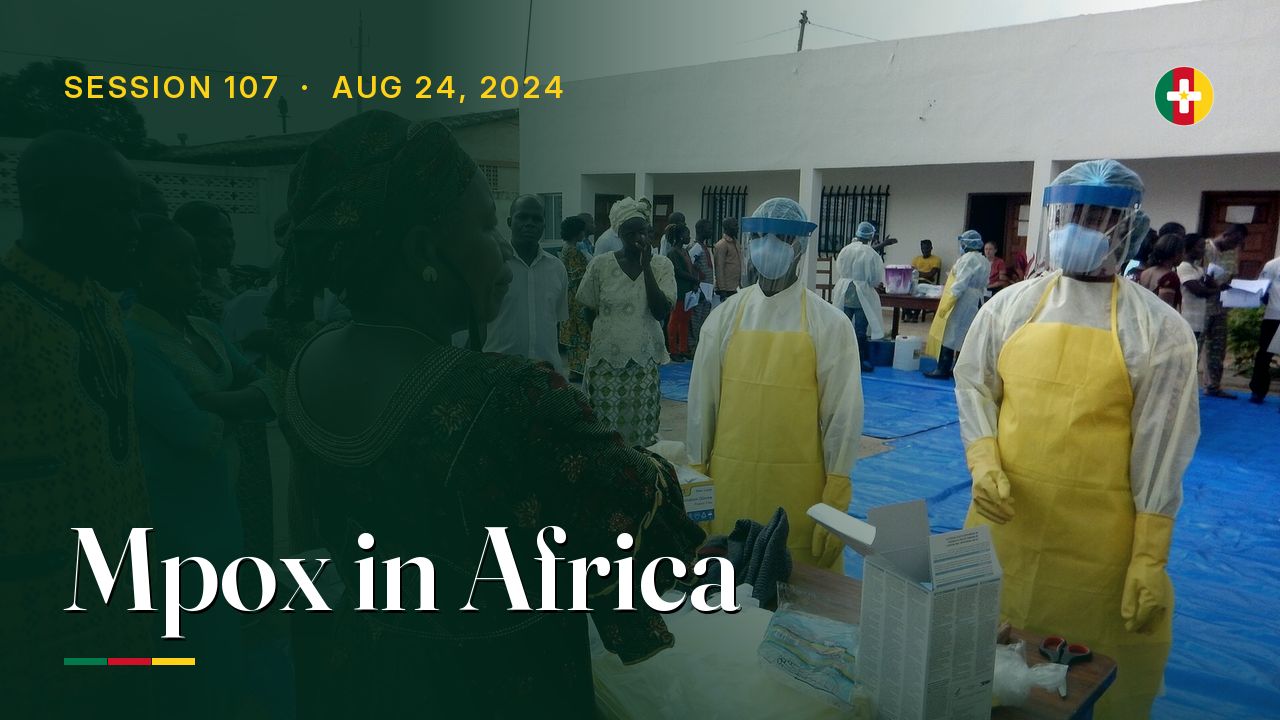
This policy briefing synthesizes key insights from the Cameroon Townhall for Healthcare Professionals meeting held on August 24, 2024 (107th edition), focusing on the theme "The State of the Mpox Outbreak in Africa," an open discussion led by Dr. Bryan Tegomoh with Dr. Boghuma Kabisen Titanji of Emory University.
Context
WHO and Africa CDC declared mpox an emergency in August 2024 after a new strain, clade Ib, spread from the DRC to 16 other African countries. Cameroon is the only country where both clades have been detected and had about 35 cases in the past year.
Key issues
- Little testing. Only about 10% of suspected cases in the DRC were confirmed; testing in Cameroon is centralised at Centre Pasteur in Yaoundé.
- Clinicians unfamiliar with the disease. Mpox has been rare, so many health workers do not know how to recognise it, sample it or protect themselves.
- Vaccine access. About 10 million doses are needed, supply is limited, the price is about 80 to 100 dollars a dose, and emergency use licensing has lagged.
- Uncertain treatment. Tecovirimat did not shorten illness in the DRC trial, but good supportive care brought mortality to about 1.5%.
- Underinvestment. Most African countries spend under 1% of GDP on health and research and rely on donors.
Discussion highlights
- Participants agreed responses must be tailored to how the virus spreads locally, not copied from COVID-19.
- Ring vaccination of close contacts was favoured as targeted and less stigmatising.
- Existing GeneXpert machines could host mpox tests once validated for clade I.
- Sequencing builds long-term preparedness but does not trace transmission chains for this slow-mutating virus.
Recommendations
- Train front line clinicians now. MINSANTE and regional delegations should circulate a one page guide on recognising mpox, PPE, sampling and storage, isolation, supportive care and notification, and run short sessions for district hospitals. First step: a webinar for district medical officers with diaspora infectious disease specialists.
- Decentralise testing. MINSANTE, Centre Pasteur and partners should validate and deploy mpox cartridges on existing GeneXpert machines and set up sample transport from every region, with results within 48 hours. First step: confirm which PCR assays detect clade Ib.
- Contact tracing and community education. Regional delegations and community health workers should trace contacts of confirmed cases and explain how mpox spreads (close contact, sex, shared quarters), especially in displaced and forest-adjacent communities.
- Prepare a targeted vaccination plan. MINSANTE and the national regulator should secure emergency use licensing for MVA-BN and plan ring vaccination of contacts and protection of front line health workers, avoiding stigmatising group targeting. First step: an emergency use review of MVA-BN.
- Strengthen genomic surveillance. The national public health laboratory, with the Africa CDC Pathogen Genomics Initiative, should sequence a sample of confirmed cases quickly, share quality sequences, and invest in computing and stable power.
- Fund preparedness domestically. The government should commit its own emergency funds to the response, following the DRC's 10 million dollar pledge.
Next steps
The town hall planned its next session in two weeks, with the Minister of Public Health if available, and invited the South West regional team to share its surveillance update.
Conclusion
Participants agreed that the most effective response for Cameroon now is informed clinicians, faster testing, contact tracing and honest public communication, backed by domestic funding. Vaccines and new drugs matter, but they should be deployed with a strategy fitted to local transmission.
Meeting minutes
Agenda
- Welcome and change of programme: the Minister of Public Health was unable to attend because of the mpox response
- Opening questions by the Chair and Dr. Marthe-Sandrine Mpollo
- Overview of mpox by Dr. Bryan Tegomoh
- Expert remarks and answers by Dr. Boghuma Kabisen Titanji
- Open discussion and Q&A
- Closing messages and adjournment
Opening remarks
- Dr. Tegomoh welcomed participants to the 107th session. The previous session and this one had been scheduled for the Minister of Public Health to update the town hall on universal health coverage, but he was occupied with the mpox response.
- He noted that WHO had declared the mpox situation in Africa a public health emergency of international concern, and that Africa CDC had declared its first ever public health emergency of continental security the day before. He said Cameroon is the only country where both clades of the mpox virus have been detected.
- The session was turned into an open dialogue on lessons from COVID-19, what Cameroon and Africa can do better, and what questions remain unanswered.
- The Chair welcomed Dr. Marthe-Sandrine Mpollo to the moderation team. She asked what can be done to protect African populations who lack access to the antiviral treatment.
Presentation
1. What mpox is
Dr. Tegomoh, who co-authored a 2022 contemporary review on mpox with Dr. Titanji and colleagues, said the virus was first identified in imported monkeys in Denmark in 1958 and the first human case was a nine-year-old child in 1972. The name was changed from monkeypox because of stigma. Clade I predominates in Central Africa and clade II in West Africa; clade IIb drove the 2022 global outbreak, mostly among men who have sex with men. People born after smallpox vaccination ended have no vaccine-induced protection, and zoonotic spillover is rising with deforestation.
2. How the outbreaks evolved
Dr. Titanji said 2022 was the first time sustained human-to-human transmission was seen outside endemic countries. Transmission is through close contact with active lesions, of which sex is one form. Viruses from Nigeria in 2017 and 2018 and from 2022 carry a signature of APOBEC3 mutations, which shows sustained human spread but does not by itself prove the virus became more transmissible. Since 1980 a large unvaccinated population has grown and become more mobile. In a cluster of 241 people in a DRC mining town, divergent sequences with the same signature defined a new strain, clade Ib, now exported to 16 other African countries, and clade I has been associated with higher mortality.
3. Treatment
Dr. Tegomoh said an NIH-supported trial released the week before found tecovirimat safe but no faster than placebo in resolving symptoms of clade I disease; one hypothesis under study is mutation in the drug's target protein (VP37). Dr. Titanji said tecovirimat was approved in the US under the animal rule and used under emergency protocols in 2022 without randomised data, and that antivirals work best when started early. In the DRC trial, everyone received hospital supportive care (nutrition, hydration, treatment of secondary infection), and mortality fell to about 1.5%. She said the drug may still matter for young children, pregnant women and people with advanced HIV.
4. Vaccines
The MVA-BN vaccine (Bavarian Nordic), a third generation smallpox vaccine, was given in over 10 million doses in 2022 and is estimated to be 75% to 85% effective against clade IIb after two doses, with milder disease in breakthrough cases. Phase 2 studies in DRC health workers showed good immune responses, but effectiveness against clade I is not yet known; older smallpox vaccines were about 75% to 80% effective against clade I in household contact studies in the DRC. A Japanese vaccinia based vaccine needs a special needle, and mRNA vaccines from Moderna and BioNTech are in early human studies after near complete protection in monkeys; a phase 3 trial may be three to five years away.
5. Why vaccines have not reached Africa
Dr. Titanji said wealthy countries stockpiled vaccines in 2022, and the 2022 emergency declaration did not lead to emergency use licensing in African countries; only recently has Nigeria obtained it and the DRC is working on it. Africa CDC estimated a need of about 10 million doses, Bavarian Nordic can make up to 2 million by the end of 2025, and the subsidised price of about 80 to 100 dollars per dose (two doses needed) is prohibitive. Donations from the US and the EU leave a gap.
6. Response strategy and testing
She said responses must be tailored to each country, as DRC sequences show some outbreaks driven by zoonotic spillover and others by spread in mining camps, sex work and crowded hospitals. Of about 17,000 suspected cases in the DRC, only about 10% were confirmed by testing. She advised against copying COVID-19 border screening and quarantine, and urged focus on clinician education, testing, reporting and contact tracing. Her team at Emory validated a GeneXpert (Cepheid) test for clade IIb that the FDA approved; the same machines are in most African hospitals for TB, so cartridges could be deployed once validated for clade I, whose gene deletions can defeat some common PCR tests.
7. Genomic sequencing
Dr. Tegomoh said COVID-19 led to the Africa CDC Pathogen Genomics Initiative and regional laboratories, including Cameroon's national public health laboratory. The mpox genome is large (about 196,000 bases) and hard to assemble, many public sequences are of poor quality, and Africa lacks computing capacity. Because the virus mutates slowly, sequencing identifies clade and subclade but not who infected whom. Dr. Titanji cited Sweden and Thailand, which posted sequences of imported clade Ib within 24 hours; Thailand traced more than 40 contacts and quarantined them for 21 days.
Discussion and Q&A
- Chair: what should a doctor in a district hospital, for example in Bamenda, do with a suspected case? Dr. Titanji said to wear gloves and a mask (ideally N95), swab lesions with a sterile swab and store at minus 20 degrees, isolate the patient in a single room with staff in PPE, and notify the regional delegation, which arranges transport of samples for testing at Centre Pasteur in Yaoundé. Patients should cover lesions with long sleeves. Most people recover in two to four weeks with supportive care: calamine lotion for itching, pain relief, treatment of bacterial superinfection, nutrition and hydration. People are no longer infectious once lesions have fully healed with new skin; those sent home should isolate in their own room and not share utensils.
- Elvis Ndansi: should countries use rapid tests and border screening as in COVID-19? Dr. Titanji said no single approach fits all and that resources should go to recognising, testing, reporting and contact tracing rather than screening everyone at entry points.
- Dr. Marthe-Sandrine Mpollo: after COVID-19 had less impact in Africa than feared, how should we educate people, and should the focus be on supportive care rather than sequencing? Dr. Titanji agreed that, for this outbreak, money is best spent on educating clinicians and the public. She said mpox has an R0 below one (for clade IIb), against two to three for COVID-19 and 12 to 16 for measles, and that behaviour change did more than vaccination to contain the 2022 outbreak. Vaccination strategy should be decided by each country: ring vaccination of close contacts may make more sense than inclusion in the national immunisation programme.
- Elvis Ndansi: are there simpler tests to decide which samples to send? She described the GeneXpert test her team validated and said lateral flow antigen tests are being developed but need validation on clinical samples. The Africa CDC and WHO response plan includes rapid point of care diagnosis.
- Chair: if 20 million doses arrived, who should be vaccinated? She said who is getting mpox in each country should decide: for example, ring vaccination of households where young children are severely affected, or front line health workers where outbreaks occur in crowded facilities. Targeting groups such as sex workers risks stigma. Elvis Ndansi raised the dilemma of vaccinating men who have sex with men where homosexuality is a crime; she said ring vaccination of close contacts avoids defining groups and is more acceptable.
- A participant: how prepared is Cameroon, and how can clinicians in rural and displaced communities tell mpox from other rashes? Dr. Titanji said she does not work for the Ministry and could not comment on its plans. She said building outbreak capacity is first a national government responsibility, that most African countries invest less than 1% of GDP in health and research, and that reliance on foreign donors has repeatedly failed. The priority for Cameroon is to inform the public about outbreaks in neighbouring countries and train health workers to recognise cases, collect samples and know where to send them. The Chair said the Ministry was not represented at short notice.
- Another participant: should people born after 1980 be vaccinated against smallpox? She said this is under debate, but with vaccine mistrust and cost it may not make sense: Cameroon (about 25 to 26 million people) had about 35 mpox cases in the past year according to the WHO tracker, including outbreaks in Kumba and among internally displaced people in the South West in 2023, while it must still fund childhood immunisation. Strategy should follow risk.
- A participant (by chat): what about gene therapy for sickle cell disease? The Chair said gene therapy costs about 3 million dollars in the US and Africa lacks the platforms to scale it; the priorities remain screening, premarital counselling, education, folic acid and hydroxyurea.
- A participant who worked in the Buea health district She said the South West regional team has been active in mpox surveillance and that she had asked its head to share an update with the town hall.
Calls to action and closing
- Dr. Titanji's message: knowledge is power. Clinicians should read the WHO mpox resources and inform their communities. Mpox has grown on the continent for five decades and will not disappear without concerted effort; African leaders must invest in surveillance, and she welcomed the DRC president's pledge of 10 million dollars.
- Dr. Mpollo thanked her for walking participants through the evidence.
- The Chair said the Minister had been due in the last two sessions but could not attend, first because he could not fly back in time and now because of the mpox emergency. The next session would be in two weeks, with the Minister if he is available.
- There was no parking lot session.
Next meeting
In two weeks (early September 2024); topic to be announced, with the Minister of Public Health if available.
Submitted by the Co-Moderators, Cameroon Town Hall for Healthcare Professionals.