Health Beyond the Health Sector: Acting on the Determinants of Health in Cameroon
Overview
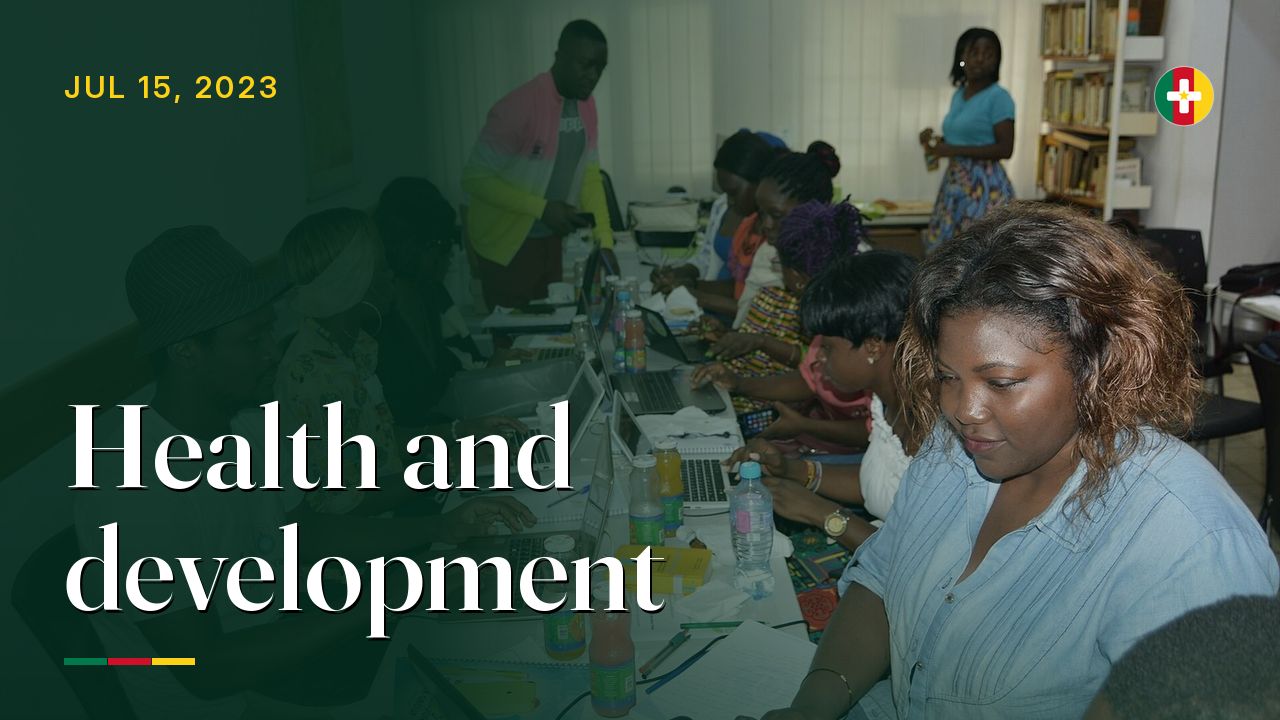
This policy briefing synthesizes key insights from the Cameroon Townhall for Healthcare Professionals meeting held in July 2023, focusing on the theme "The Intrinsic Link between Health and Development," presented by Dr. Yauba Saidu, Country Director of the Clinton Health Access Initiative in Cameroon.
Context
Cameroon has expanded and equipped its health facilities, but access to water, sanitation, electricity, roads and income remains poor, and most health spending is out of pocket. These determinants sit with ministries other than Public Health, and the session opened a series on them.
Key issues
- Access and roads. Facilities are concentrated in cities; poor roads delay emergencies and supplies, and 40 to 60% of births in the northern regions were said to occur at home.
- Water, sanitation and energy. About 60% have access to water and about 40% to basic sanitation, and many facilities lack grid electricity for night care and the cold chain.
- Poverty and financing. 60 to 70% of health spending is out of pocket and the health budget was said to be under 5% of the national budget.
- Plans without resources. National plans reflect the SDGs but are not matched by funding or built on community needs, and programmes depend on donors.
- Ministries working in silos. Health centres are built without roads, water or power, and training, employment and research of health workers sit with different ministries.
Discussion highlights
- Hygiene, sanitation and vaccination have done more for life expectancy than hospital care.
- Evidence, policy briefs and work with Parliament were proposed as the route to funded policy.
- Medical students were invited to research and advocate as civil society.
- Local taxes should fund visible services, and citizens should be able to read and question budgets.
- Participants proposed inviting other ministers to the town hall, one goal at a time.
Recommendations
- Plan new facilities with other ministries. MINSANTE, with the ministries in charge of water, energy and public works, should require that every new health facility has a plan for road access, water and power before construction. First step: a joint checklist used by regional delegations when sites are approved.
- Set up an intersectoral health committee. The government should establish a standing committee of the ministries whose work most affects health (water and energy, public works, agriculture, education, higher education, public service, finance), with shared indicators drawn from the national development strategy 2020 to 2030.
- Raise domestic health financing. MINSANTE and the Ministry of Finance should set a path to raise the health budget toward the 15% Abuja target and expand universal health coverage, reducing out of pocket payments. First step: publish the health budget by region in a simple citizen version.
- Use council resources for basic services. Councils, under decentralisation, should allocate part of local revenue to water and sanitation at health facilities, with support to build council planning capacity.
- Turn town hall sessions into policy briefs. The town hall, diaspora professionals and partners such as CHAI should produce a bilingual brief after each session and send it to the relevant ministers, and train medical students in research to build local evidence. First step: a student-led paper on the determinants of health in Cameroon.
- Bring other ministers to the dialogue. The town hall should invite ministers responsible for water, energy and public works to present their plans and how they affect health.
Next steps
Participants were to suggest which minister to invite first. Dr. Saidu proposed a session on a strategy for the town hall. An email on the new MINSANTE diaspora working group was to be sent, and the town hall was working toward CME credits by year end.
Conclusion
Better health in Cameroon depends on water, sanitation, energy, roads, education and incomes as much as on hospitals. Participants agreed that health needs a voice in every ministry, funded plans built on community needs, and evidence turned into policy.
Meeting minutes
Agenda
- Welcome and opening remarks by the moderators, Elvis Ndansi and Dr. Bryan Tegomoh
- Remarks by the Chair, Dr. Munoh Kenne Foma
- Participant introductions
- Presentation by Dr. Yauba Saidu on the link between health and development
- Discussion and Q&A, moderated by Dr. Bryan Tegomoh
- Closing remarks, announcement on the MINSANTE diaspora working group, and adjournment
Opening remarks
- Elvis Ndansi said earlier sessions kept running into determinants outside the health sector, such as roads for emergency transport, agriculture for malnutrition and insecurity for gunshot and fracture care in the North West and South West, and introduced this session as the first of a series bringing in actors from outside health.
- Dr. Tegomoh said rethinking public health in Cameroon requires engaging the private sector, the public sector, non-governmental organisations and other countries.
- The Chair said he had recently heard at a tumour board how CHAI supports access to oncology medicines in Cameroon, including at Mbingo, and noted its role in reducing HIV among adults.
- Elvis Ndansi cited CHAI's support to the government on medical oxygen supply for hospitals and on vaccine cold chain, including refrigerators donated during COVID-19.
Presentation
1. Health facilities are not enough
Dr. Saidu paid tribute to the Minister of Public Health, Dr. Manaouda Malachie, for a period in which the number of health facilities grew by about 20% and regional hospitals received modern equipment such as CT scanners. He said these facilities are concentrated in the big cities and regional capitals, and that this large investment will not improve health outcomes if other determinants are not addressed.
2. Roads and access
Poor roads delay patients in emergencies and disrupt the supply of syringes, needles and medicines. He said the problem is most acute in the northern regions, where patients may travel hundreds of kilometres, which may help explain why 40 to 60% of babies there are born at home.
3. Health as a condition for the economy
A sick population cannot farm, which leads to hunger and can feed insecurity. Outbreaks such as COVID-19 and Ebola slow economies and raise government spending, as does the rising burden of non-communicable diseases and injuries. Disease shrinks the workforce, as HIV did in the late 1990s and 2000s, and malnutrition affects children's ability to learn and increases school dropout.
4. The Sustainable Development Goals
Four of the 17 goals relate directly to health and the other 13 indirectly. He said progress in Cameroon is off track on poverty and hunger, and that the education goal focuses on primary school although a mother's level of education strongly predicts whether children are fed well, vaccinated, sleep under bed nets and whether the family uses family planning.
5. Water, sanitation, energy and other indicators
He cited access to water at about 60% nationally, with communities in the Far North, North and Adamawa where women and children walk for hours to a water point, and access to basic sanitation at about 40%. Many health facilities are not on the national grid, which affects night deliveries and the storage of vaccines and oxytocin. He cited almost 20% of people living on less than $1.90 a day, about 31% of children malnourished, about 10 to 11% of adults over 30 obese, about 2.1 to 2.2 health facilities per 10,000 people, and 60 to 70% of health spending paid out of pocket.
6. Levels of determinants
He grouped determinants into individual factors (genetics, age, sex), governance and policies (employment, working conditions, regulation of medicines and food), the physical environment, health behaviours and the social environment. Using the UNICEF conceptual framework on maternal and child nutrition, he said clinicians treat the immediate causes, while lasting change needs action on the underlying and basic causes, which lie largely outside the Ministry of Public Health.
7. Who should do what
He named priority areas for wider dialogue: economic development, scientific and technological innovation (diagnostics, equipment, drugs, vaccines, telemedicine), climate change and its effect on vector borne and diarrhoeal disease, political stability (citing the North West, South West and areas affected by Boko Haram) and preparedness for emerging infections. Showing Cameroon's 32 or so ministries, he gave examples of what transport, energy and water ministries could do for health.
Discussion and Q&A
- The Chair: reflection on working in a facility without water The Chair recalled being posted early in his career to a hospital near Bamenda with no potable water, where sterilising equipment and conducting deliveries were difficult and staff refused postings. He said hygiene and sanitation, vaccination and antibiotics have done more for life expectancy than hospital medicine, and that the United States has worse life expectancy than poorer countries with better social determinants.
- Dr. Samuel Ndinjiakat: comment on transport, waste and access to medicines Back from Cameroon, he said fixing communication and transport would help other determinants fall into place, described trucks stuck on roads, a lack of waste disposal and incinerators in his district, and said many of the 75 sickle cell patients at his facility could not obtain hydroxyurea. He said the Ministries of Public Health and External Relations were working on a memorandum of understanding.
- Dr. Tegomoh: how can the government build social determinants into its development agenda and engage other sectors? Dr. Saidu said the national development strategy for 2020 to 2030 already reflects the SDGs, but plans are often copied from outside models, not built on community needs, and are not matched by resources. He saw decentralisation to councils as a chance, limited by council capacity and funding, and said only economic growth can provide lasting resources. He proposed that health professionals, including the diaspora, use the US approach: document and publish evidence, turn it into policy briefs, and work with stakeholders so that bills reach the National Assembly, as with PEPFAR and the President's Malaria Initiative.
- An aspiring medical student: are medical students stakeholders, and what is their role? Dr. Saidu said they are, and that their role is research and publication to build the evidence for policy, and advocacy as part of civil society. When the student said research is not taught early in medical school, he advised students to organise and ask their universities for research training.
- A participant: should Cameroon develop policies it can fund and take small steps? Dr. Saidu agreed that implementation is the main problem. He said national plans are often adapted from documents prepared by WHO or UN experts, while funding is largely donor or loan driven and does not always match national needs. He called for national capacity to analyse, plan and mobilise resources, and for economic growth.
- The Chair: how can Cameroon fund its own priorities, how can ministries plan together (for example roads, water and power for new health centres), and how can the country use this to prevent cholera? Dr. Saidu said these were beyond his remit. A moderator then answered that 'he who pays the piper calls the tune': dependence on the Global Fund and PEPFAR lets funders shape programmes. He cautioned against loans backed by natural resources, and said taxes collected locally, for example at markets, should fund visible services such as potable water, with citizens learning to read budgets and hold leaders accountable. The speaker recalled using council law to press a mayor to supply water to a hospital. The Chair called for the health budget to rise from under 5% toward 15%, and noted that health workers are trained by one ministry, employed by another and research is run by a third, with little coordination.
Calls to action and closing
- Elvis Ndansi summarised the session and proposed asking participants which minister should be invited first for the series on determinants of health.
- The Chair said the SDGs were not designed with Africa's realities in mind and proposed taking one goal at a time with experts and ministers.
- Dr. Saidu asked the town hall to turn its sessions into concrete outputs: documentation, policy briefs in English and French sent to ministers, and papers by students on the determinants of health in Cameroon, aiming to influence one or two policies by year end. He suggested a session on a strategy for the town hall.
- The Chair announced that the Minister of Public Health had created a body through which the diaspora can work directly with the Ministry, that Prof. Theodore Ngatchu and Dr. Samuel Ndinjiakat were among its members, and that an official email would follow. He also said the town hall was working toward offering CME credits by the end of the year.
Submitted by the Co-Moderators, Cameroon Town Hall for Healthcare Professionals.